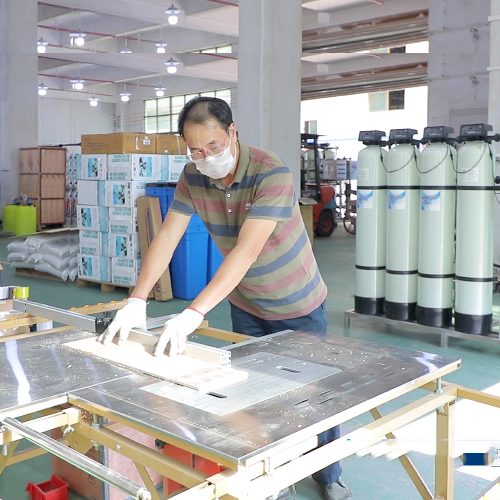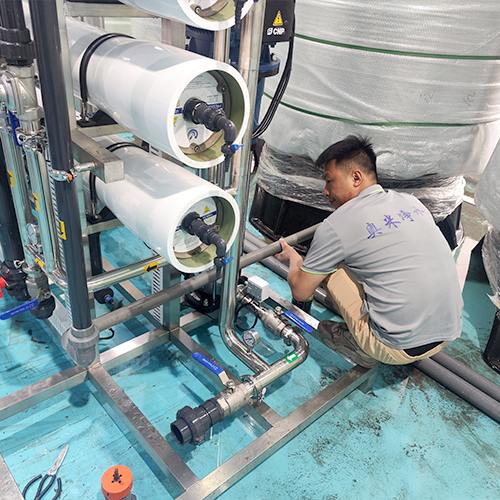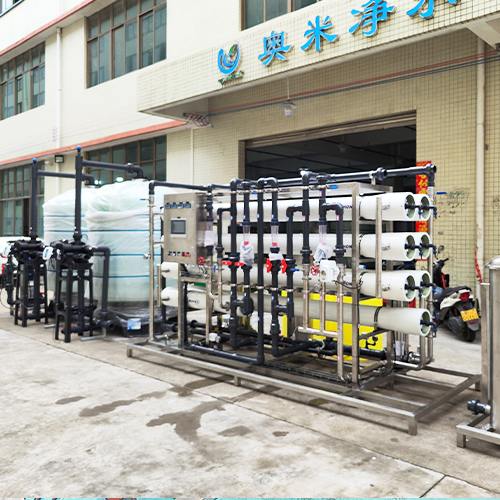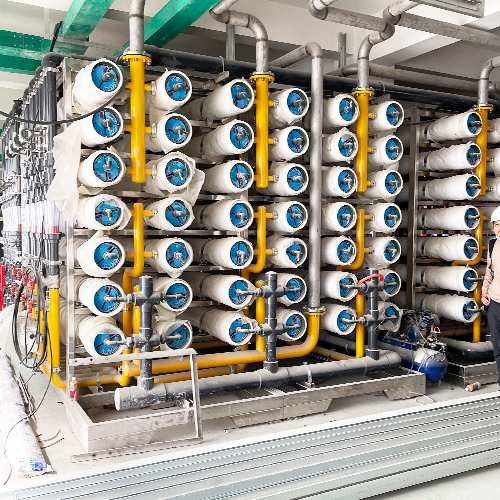
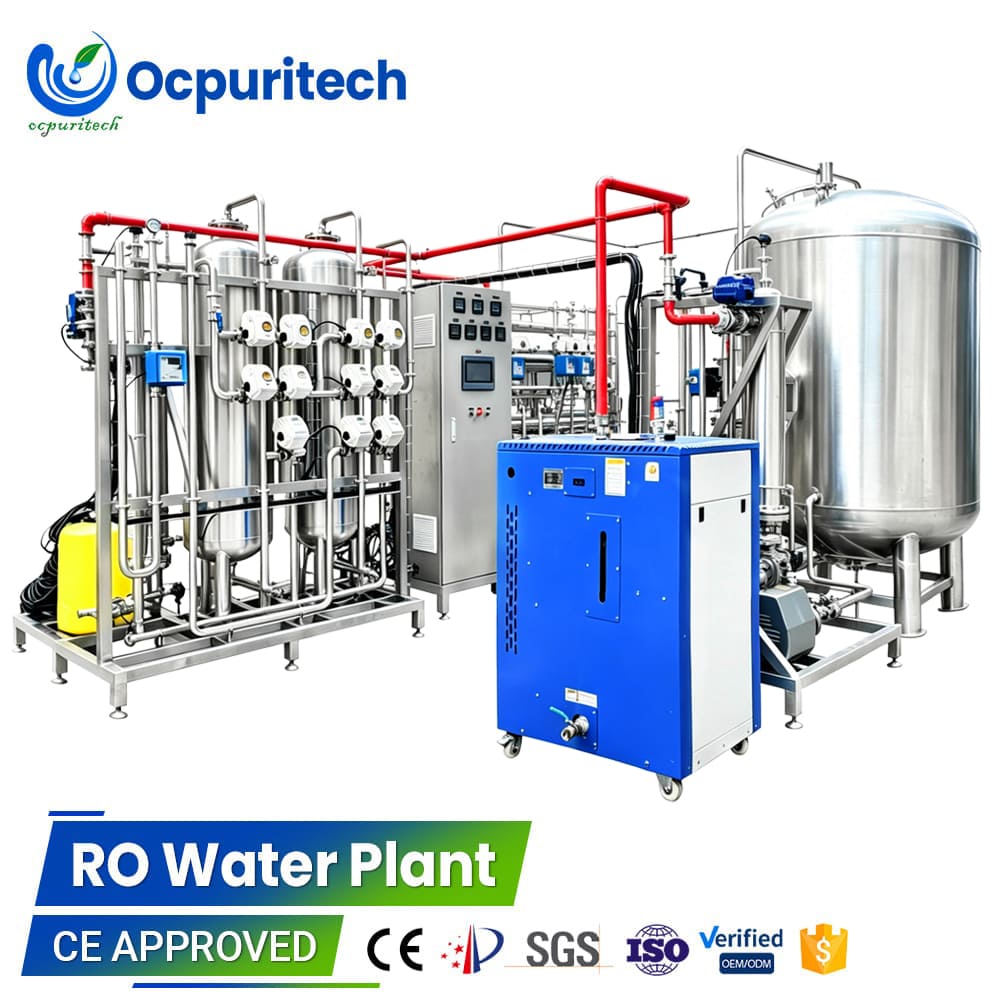
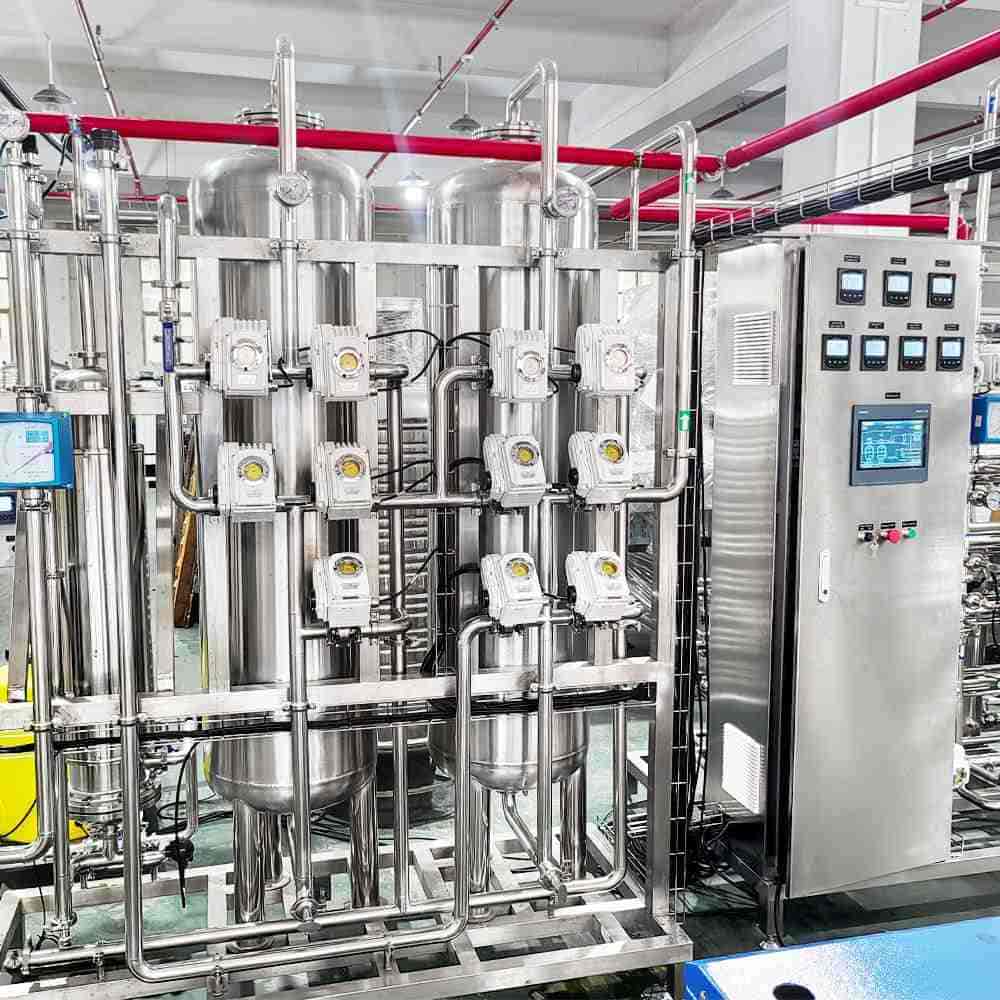
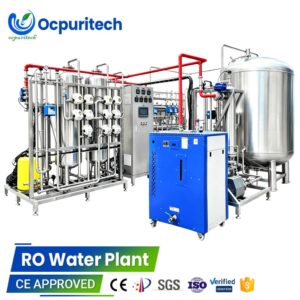
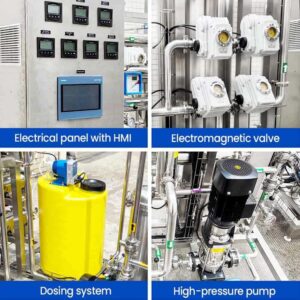
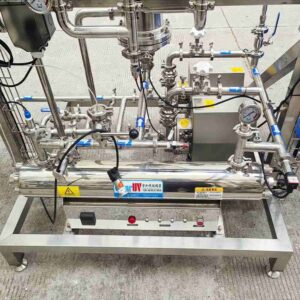
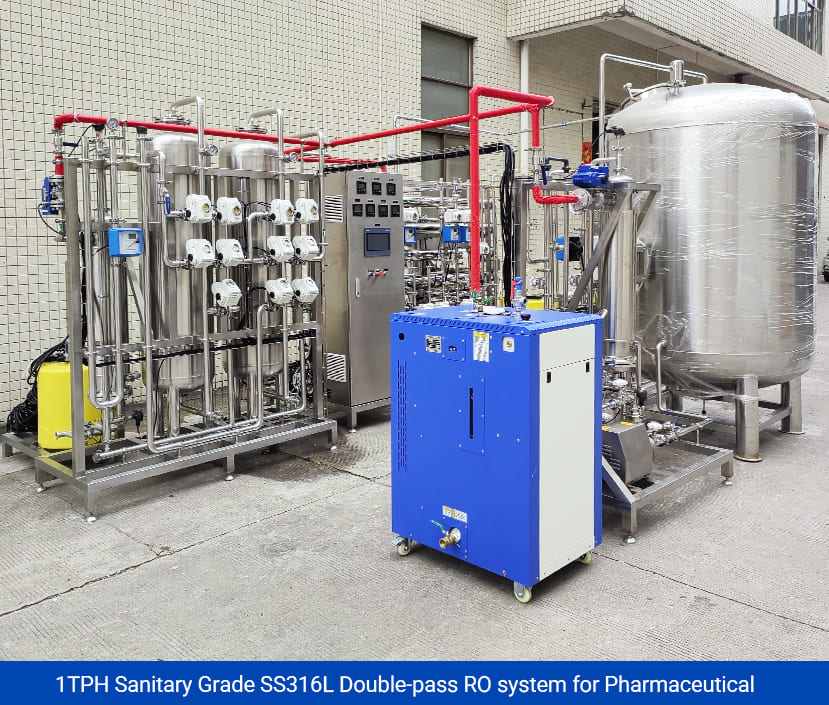
Ocpuritech builds pharmaceutical water systems in full sanitary SS316L for manufacturers who cannot accept water quality drift between batches. This 1,000 LPH double-pass RO plant was engineered, fabricated and commissioned for a pharmaceutical preparations producer in Brazil whose existing plant failed to hold a qualified water standard and suffered from poor corrosion resistance. After a full technical comparison against competing suppliers, the client selected Ocpuritech to rebuild the entire water supply chain.
The duty is unforgiving. Municipal feed water enters at 153 µS/cm conductivity, 5.7 mg/L TOC, 46 mg/L hardness and 1 NTU turbidity. Product water must leave the loop below 1.3 µS/cm, below 500 ppb TOC and below 0.2 NTU — continuously, and inside a 4 × 5 metre workshop footprint. That target demands 99.15% conductivity reduction and 91.2% TOC reduction at system level, which is why Ocpuritech specified a double-pass reverse osmosis (RO) system rather than stretching a single pass to its limit.
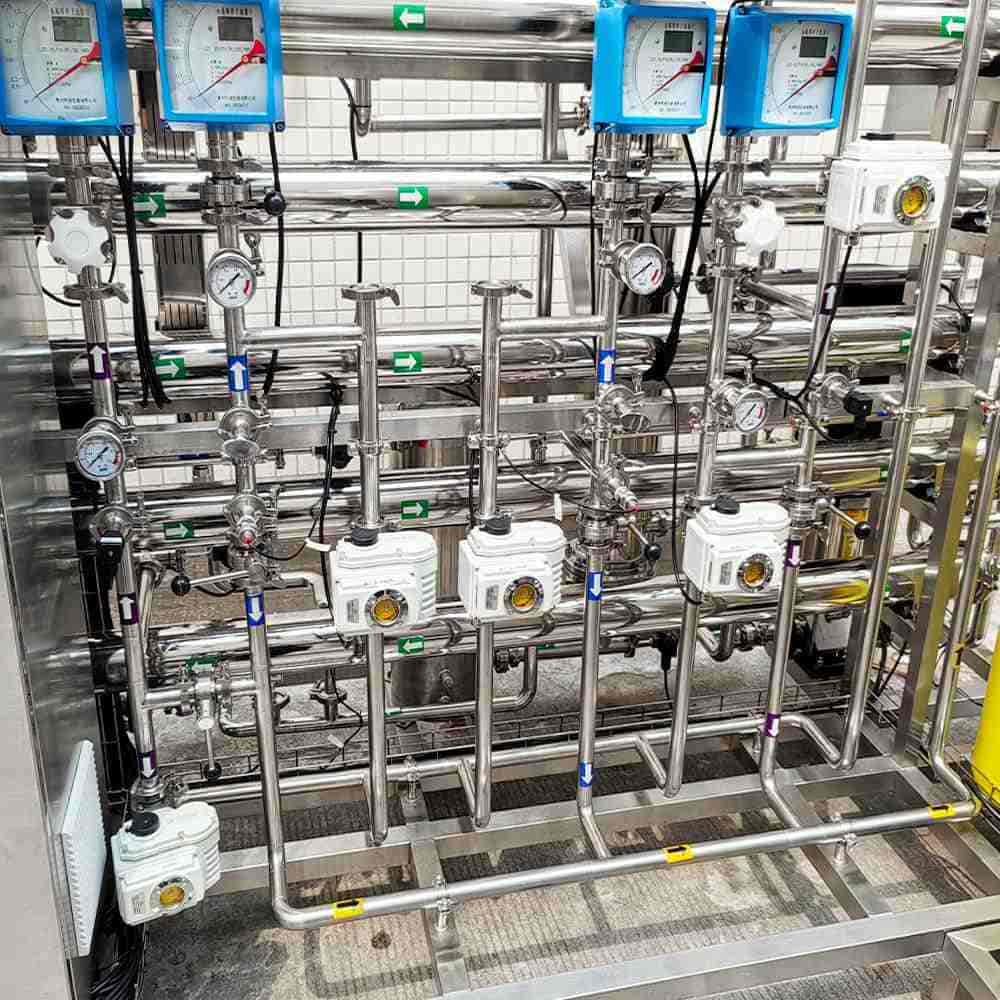
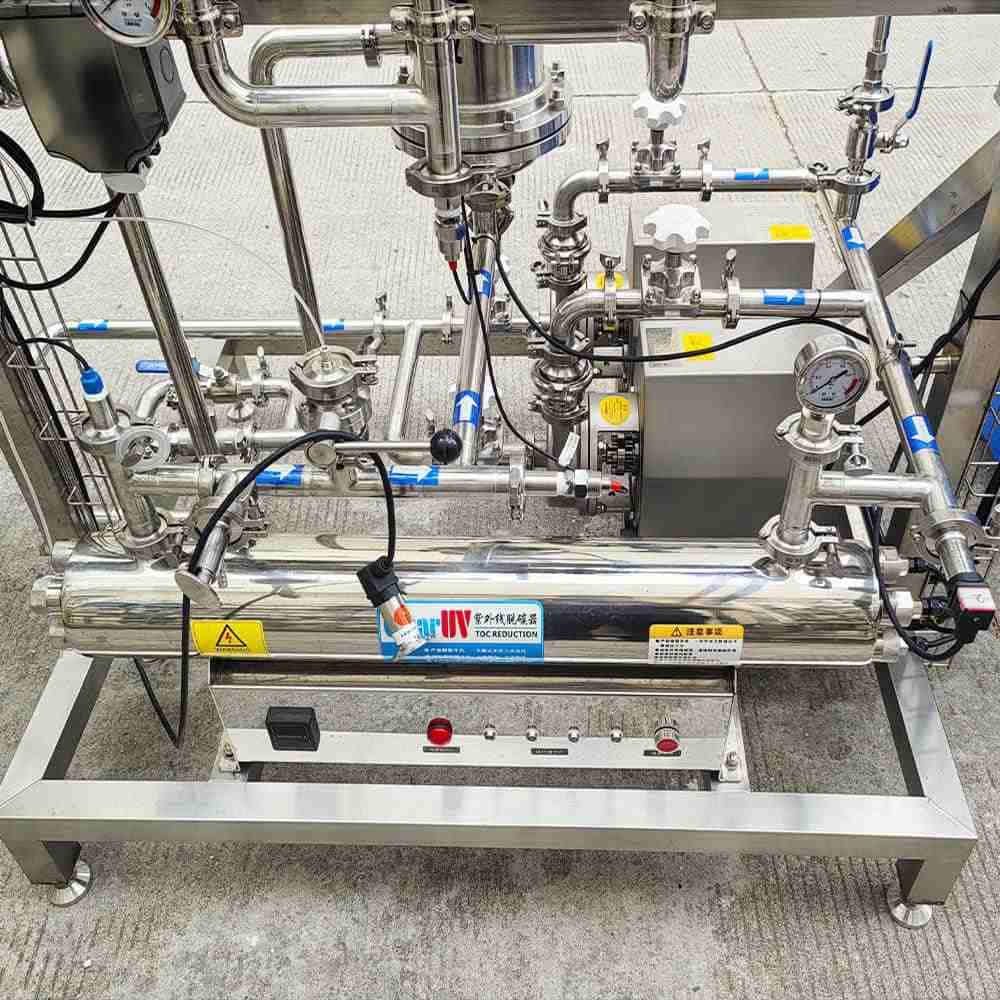
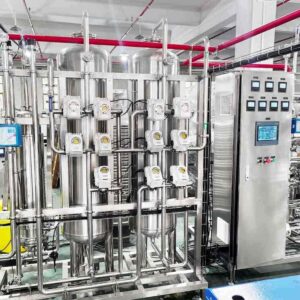
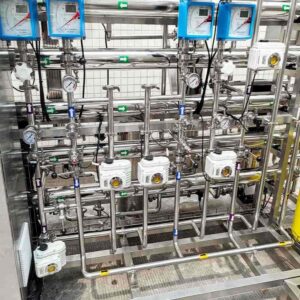
Every wetted surface is sanitary SS316L. Every process connection is orbital-welded for a uniform, dead-leg-free internal bore, and every removable joint is Tri-clamp. The complete circuit — pretreatment through RO — is pickled and passivated to strip surface rust, scale and embedded contaminants and to form an anti-corrosion passive film that protects product purity and extends service life. Online pasteurization and a dedicated RO CIP circuit are built in, so sanitization is a scheduled operation rather than a shutdown event.
This is what a pharma water system should be: a documented process, a verifiable material specification, and a set of performance numbers that can be audited before anything is signed.
How It Works — The Engineering Behind the Numbers
Most suppliers describe pharmaceutical water systems as producing “pure water” and stop there. Ocpuritech publishes the numbers that determine whether a plant actually can — step by step, using actual project water data.
Step 1 — Municipal feed intake: Raw water enters at 153 µS/cm conductivity, 5.7 mg/L TOC, 46 mg/L hardness and 1 NTU turbidity. These are the conditions the pretreatment train must tame before the membranes ever see the water.
Step 2 — Pretreatment: Turbidity, hardness load and organic fouling potential are reduced to a stable membrane feed. Pretreatment is not an accessory — it protects the RO capital investment and extends membrane service life.
Step 3 — First RO pass: The bulk salt and TOC load is rejected here. First-pass duty is sized at 90.78% per-pass conductivity rejection — below the membrane’s rated ceiling — so the membrane bank carries a designed-in ageing margin. As elements age, conductivity at the first-pass outlet rises slowly; the second pass absorbs that rise without pushing the product outlet out of specification.
Step 4 — Second RO pass: First-pass permeate is re-processed, driving residual conductivity below 1.3 µS/cm with headroom. Running two passes at a conservative per-pass duty is what converts a specification target into a guarantee across the membrane lifetime.
Step 5 — Loop, supply and circulation: Product water enters a continuous-motion loop. Nothing stagnant, no standing volume for bioburden to develop, no dead zones. The loop delivers to batching, production preparation and workshop cleaning simultaneously.
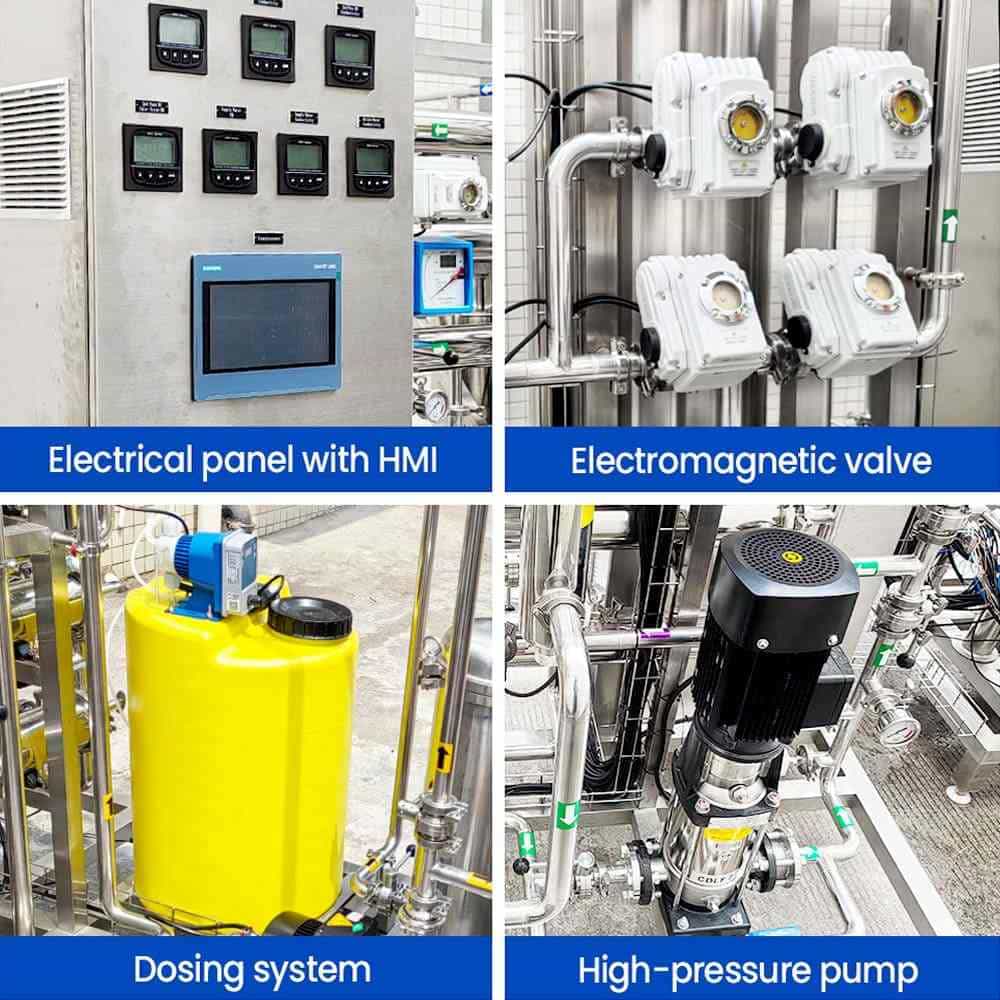
Step 6 — Online pasteurization and RO CIP: Thermal sanitization covers the pretreatment and RO sections on a planned cycle. A dedicated CIP circuit restores membrane flux on schedule. Both are engineered into the skid — not retrofitted — so sanitization is an operational procedure, not a dismantling event.
System Configuration — Seven Integrated Sub-Systems
Sanitization Route
This plant sanitizes thermally. Online pasteurization covers both the pretreatment and RO sections, and the dedicated CIP circuit restores membrane performance on a planned interval — not in response to a quality failure.
Thermal sanitization is the correct route for a fully orbital-welded SS316L loop: there are no dead zones for bioburden to survive, no elastomer inventory to degrade, and no ozone-destruct infrastructure to commission.
Ozone sanitization of pharmaceutical water systems follows a different engineering route. It imposes specific material compatibility requirements, ventilation design and ozone-destruct sizing, and it must be engineered into the loop geometry at design stage rather than retrofitted. Where a client SOP or local regulator specifies that route, Ocpuritech’s R&D team scopes ozone sanitization against the loop geometry at design stage.
Project Case Study — 1 TPH Pharmaceutical Plant, Brazil
Client: Pharmaceutical preparations manufacturer
Application: Pharmaceutical batching, production preparation, workshop cleaning
Challenge: Existing equipment failed to hold a qualified water standard and exhibited poor corrosion resistance. After a full technical comparison across multiple suppliers, the client awarded the project to Ocpuritech to rebuild the entire water supply chain with a fully compliant pharmaceutical water system.
Project Data Sheet
How Ocpuritech Engineered the Solution
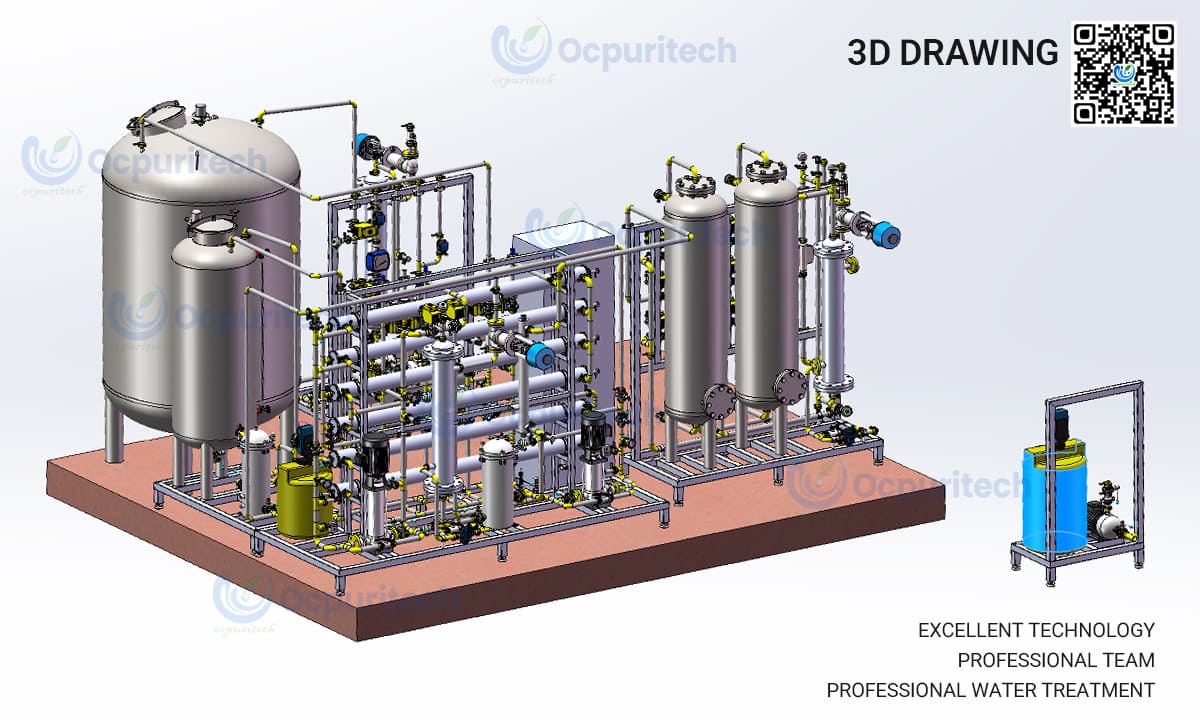
The client supplied a pre-design. Ocpuritech refined the process against the actual 1,000 LPH capacity and the custom sanitary requirements, then confirmed the detailed configuration of every sub-system. A colour-coded flow chart was issued with each component individually named and each pipeline class in its own colour — so the client could read the entire process, not just the equipment list, before fabrication started.
Engineering disciplines involved:
- Design engineers — 3D models and technical drawings in CAD/SolidWorks
- R&D engineers — process development and component selection for pharmaceutical-grade sanitary duty
- Electrical engineers — PLC control system build and commissioning
- Test engineers — product, process and system validation before shipment
Applications for Pharmaceutical Water Systems
Ocpuritech engineers GMP-grade water treatment systems for duties where water quality is a compliance obligation, not a preference:
- Pharmaceutical preparation manufacturing — purified water for API and finished-product batching at guaranteed conductivity and TOC, batch after batch, with a documented audit trail
- Production preparation and equipment rinsing — final-rinse water that leaves no ionic or organic residue on process contact surfaces
- Cleanroom and workshop cleaning supply — sanitary loop water for GMP-controlled production areas
- Biotech and laboratory feed water — low-TOC, low-conductivity pretreatment upstream of an EDI ultrapure water system or a final polishing stage
- Hospital and medical device reprocessing — sanitary-grade purified water where corrosion products and bioburden are clinically unacceptable
- Cosmetics, food and beverage operations requiring pharmaceutical-grade construction — water treatment built to a higher material standard than the industrial minimum
Feed water outside the municipal envelope — borehole, brackish, high-TOC surface water or high-hardness groundwater — carries a different fouling and rejection duty. Ocpuritech re-engineers the same double-pass architecture around each project’s water analysis report. There is no fixed configuration to reuse; every project starts from real water data.
Why Choose Ocpuritech Water Treatment Equipment?
Manufacturer, not trader. Guangzhou Aomi Water Purification System Manufacture Co., Ltd. has built every class of water treatment system under the Ocpuritech brand since 2011 — over 1,000 completed projects, more than 7,000 customised systems, exported to over 80 countries.
In-house engineering discipline. Four engineering roles sign off every project: design (CAD/SolidWorks 3D models and drawings), R&D (process and new-technology development), electrical (PLC system build and maintenance), and test (product, process and system validation before shipment).
Sanitary construction built for inspection. Full SS316L, orbital welding with no dead zones, Tri-clamp process connections, pickling and passivation across the wetted circuit. Tri-clamp connections exist precisely so the operator can open the circuit and verify the build against the material certificates.
Certified and audited. ISO 9001:2015 quality system, supported by CE, NSF and SGS credentials and Ocpuritech patents.
Customisation as the default workflow. The Brazil plant began as the client’s pre-design and finished as an Ocpuritech-refined process carrying a colour-coded, component-named flow chart. Every project follows that same route: refine the process against real hydraulics, confirm each sub-system, then fabricate. Consequently, a specification for pharmaceutical water systems arrives as engineering, not as a catalogue entry.
Request a Free Water Treatment Technology Solution
Ocpuritech is ready to scope it. Send your feed water analysis report, required product water standard, capacity requirement and any SOP or regulatory constraint to:
Email: [email protected]
Our R&D and design engineers will return a documented process proposal — capacity calculation, per-pass rejection breakdown, sub-system configuration and material specification — within 1 business days.