A dairy plant removing particles from raw milk needs a different filtration system from one concentrating whey or reducing mineral content. Choosing the wrong technology can increase operating costs, affect product quality, and create unnecessary processing steps.
A milk filtration machine removes impurities, separates components, or concentrates liquids using filtration technologies like mechanical filters, microfiltration, ultrafiltration, nanofiltration, and reverse osmosis. Whether you’re removing impurities, concentrating protein, or dewatering whey, the best system is the one that reliably achieves your desired outcome.
Selecting the right system depends on factors like raw material type, production goals, and filtered product applications.
What Is a Milk Filtration Machine and How Does It Work?
Milk filtration works differently depending on the technology used. Mechanical filters capture particles as milk passes through a filter medium. By contrast, membrane systems separate components according to membrane properties and operating conditions.
In a crossflow membrane system, the feed liquid flows along the membrane surface. Selected components pass through as permeate, while retained components remain in the retentate stream. For UF, this allows proteins to be concentrated while much of the water, lactose, and dissolved minerals pass through. RO primarily removes water, while NF can combine concentration with partial demineralization.
For instance, raw milk may need filtering to remove sand particles before further processing. Whey protein producers might use ultrafiltration for protein concentration or reverse osmosis for pre-concentration. Each machine has a unique function.
Types of Milk Filtration Equipment for Dairy Processing
Milk filtration equipment range from mechanical filters for particle removal to advanced systems like ultrafiltration (UF) and nanofiltration (NF) for component separation or concentration. The right choice depends on your specific product goal, not just filtration precision.
Therefore, equipment selection should not rely on nominal filtration pore size alone. If a dairy plant only needs to remove suspended particles from raw milk, a suitable mechanical filtration or clarification system may be sufficient. Installing an advanced NF or RO system would add complexity without addressing the actual processing requirement.
For whey protein concentration, UF is usually more relevant because it retains proteins while allowing much of the lactose and dissolved minerals to pass through. If the resulting UF permeate needs further concentration or partial demineralization, RO or NF may be considered in a subsequent processing stage. Process viability depends on targeted component fractionation rather than theoretical membrane rejection limits.
| Technology |
Key Characteristics |
Use Case Examples |
| Mechanical Filters |
Traps particles; basic filtration. |
Protecting pumps and heat exchangers from damage. |
| Microfiltration |
Can reduce selected microbial loads and separate specific dairy components under suitable process conditions. |
Reducing microbial load in low-fat milk. |
| Ultrafiltration |
Retains proteins; concentrates large molecules. |
Whey protein and milk component adjustment. |
| Nanofiltration |
Partial desalination while concentrating liquids. |
Reducing salt content in whey permeate. |
| Reverse Osmosis |
Removes water; pre-concentrates liquids. |
Preparing whey for evaporation and drying. |
Nanofiltration vs. Reverse Osmosis: Which Is Better for Dairy Processing?
NF and RO serve different purposes in dairy processing. RO is generally preferred for water removal and pre-concentration, while NF is useful when partial mineral removal is also required.
For whey powder production, RO can reduce the amount of water entering the evaporator. However, if the product requires partial demineralization, NF may be more suitable.
NF performance depends on feed composition, membrane selection, and operating conditions. For example, sweet whey and acid whey differ in pH and mineral content, so the same membrane may not deliver identical separation results. For strict product specifications, pilot testing helps verify membrane performance and concentration limits.
| Feature |
Nanofiltration (NF) |
Reverse Osmosis (RO) |
| Primary Function |
Concentration with partial demineralization |
Water removal and concentration of dairy liquids |
| Applications |
Desalination of whey permeate; treating small molecules |
Pre-concentration for evaporation; water separation |
| Permeate Quality |
Contains salts and small molecules |
Primarily water; suitability for reuse depends on actual water quality and intended application |
| Energy Considerations |
Depends on pressure, feed composition, and concentration targets |
Depends on pressure, membrane flux, and required water removal |
How to Choose the Right Milk Filtration Machine?
Feed composition, hourly processing capacity, target concentration factor, and final product specifications are the starting points for selecting a milk filtration machine. Together, they help establish the appropriate separation process, membrane area, and operating conditions.
For NF and RO systems, the plant’s daily operating hours and cleaning schedule are just as important as nominal capacity. A machine may meet the required flow on paper yet fall short if cleaning interrupts production or permeate flux declines as the feed becomes more concentrated.
Equally important, hygienic design needs close attention. Dairy processing equipment should use suitable food-contact materials, cleanable components, and a properly designed Clean-in-Place (CIP) system. Cleaning procedures must be compatible with the membranes and other product-contact components.
| Criteria |
Key Considerations |
Impact |
| Raw Material Type |
Raw milk, whey, or permeate? |
Affects filtration method needed. |
| Processing Capacity |
Feed flow (L/h), target concentration factor, and operating hours. |
Determines system size and efficiency. |
| Membrane Type |
Is UF, NF, or RO required? |
Matches filtration needs to production goals. |
| Hygiene Design |
Materials, seals, and cleanability. |
Supports hygienic operation and compliance with applicable food safety requirements. |
| Integration |
Compatible with existing systems? |
Simplifies installation and reduces costs. |
Why a 5,000 L/h Capacity Rating Doesn’t Tell the Whole Story
A dairy plant processing 5,000 L/h of whey at a twofold volume concentration factor would theoretically produce 2,500 L/h of concentrate and 2,500 L/h of permeate, excluding losses.
However, this calculation doesn’t account for membrane fouling, viscosity changes, or declining permeate flux as whey becomes more concentrated. Before selecting equipment, confirm whether the rated capacity refers to feed flow, permeate flow, or concentrate output—and whether the system can maintain the required throughput at the target concentration.
Milk Filtration Machine Price and Operating Costs
The price of a milk filtration machine depends on the filtration technology, processing capacity, membrane configuration, hygienic design, and automation. A basic raw milk filter and a complete NF or RO system have very different equipment costs.
For dairy membrane systems, operating expenses can include electricity, membrane replacement, CIP chemicals, cleaning water, maintenance, and wastewater management. A reliable TCO (Total Cost of Ownership) evaluation balances these operational inputs directly against the net output of on-spec concentrate.
| Cost Component |
Details |
Impact on Operation |
| Initial Price |
Equipment, automation levels, and delivery scope. |
Determines upfront investment. |
| Energy Costs |
Depends on pressure and capacity. |
Major operational expense. |
| Membrane Replacement |
Lifespan depends on usage intensity. |
Adds recurring costs to long-term operations. |
| Cleaning Costs |
CIP system or custom cleaning requirements. |
Affects downtime and consumable expenses. |
| Waste Management |
Permeate disposal or reuse. |
Influences environmental and operational costs. |
How to Compare Milk Filtration Machine Quotations
• Proposal A may offer lower initial capital expenditure by minimizing total membrane surface area. However, operating at high flux rates often accelerates membrane fouling, necessitating frequent CIP cycles, reducing daily run times, and shortening membrane lifespan.
• Proposal B may require higher initial investment for expanded membrane area, lower operating flux, and variable frequency drives (VFDs), resulting in lower long-term energy consumption, reduced chemical usage, and consistent throughput.
Two quotations are only comparable when their delivery scopes match. Depending on the process, the package may need feed pretreatment, sanitary pumps, membrane modules, CIP equipment, instrumentation, process controls, and connecting pipework.
Factory testing, installation guidance, commissioning, spare parts, and project documentation should also be listed explicitly. Without those details, a lower-priced offer may simply leave the dairy plant to purchase essential equipment or services separately.
NF & RO Milk Separation Skid for a Brazilian Dairy Plant
For a dairy processor in Brazil, we built a custom sanitary AISI 316L Nanofiltration & Reverse Osmosis (NF & RO) Filter used for whey desalination, protein concentration, and permeate water reclamation.
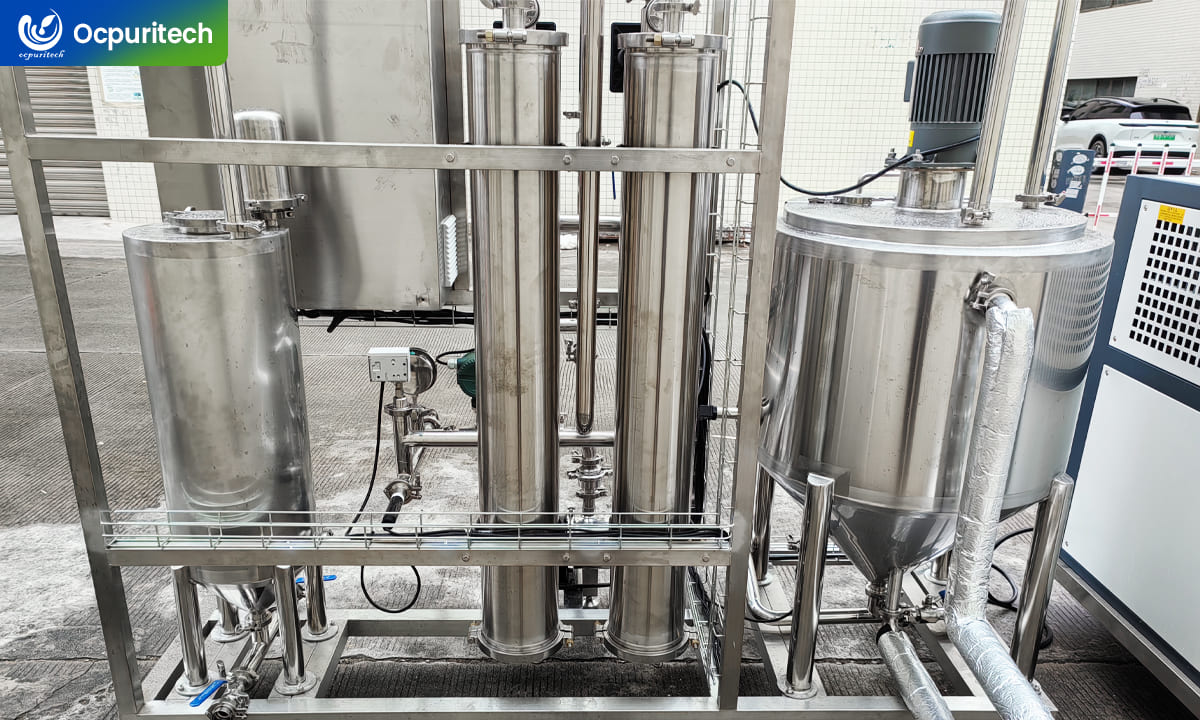
| Subsystem |
Key Components & Specifications |
Engineering Highlights |
| Feed & Mixing Tanks |
• 150L SS316L mixing tank with sanitary agitator & cooling jacket (6 HP chiller)
• 50L SS316L buffer tank; 4–20 mA level sensors & 0–100°C RTD probes |
Bottom-outlet design helps reduce retained liquid and supports easier drainage and cleaning. |
| Sanitary Pumps |
• Feed Pump: NanBeng CHL2-30 (2 m3/h2 m3/h @ 4.33 bar, 0.75 kW)
• High-Pressure Pump: NanBeng CDLF2-13+CDH2-18 (2 m3/h2 m3/h @ 36.4 bar, 7.0 kW) |
Siemens VFD control allows pump-speed adjustment to support flow and pressure regulation during processing. |
| Membrane Skid |
• 600 psi SS316L 8038 housing for 2× NF/RO elements
• 4× 3/4″ SS316L sanitary sampling valves |
Designed to accommodate the specified NF/RO membrane elements, with membrane compatibility verified for each process. |
| Piping & Hygiene |
• Full AISI 316L stainless steel
• Orbital TIG welded joints |
Sanitary, crevice-free design fully compatible with automated CIP cycles. |
Conclusion
Choosing the right milk filtration machine requires more than comparing filtration technologies or equipment prices. Mechanical filtration, MF, UF, NF, and RO serve different purposes. The right choice depends on the feed material, separation objectives, production capacity, and final product requirements.
Therefore, before requesting a quotation, prepare your feed type, hourly processing capacity, available composition data, target product specifications, and expected operating schedule. These details help equipment suppliers evaluate the appropriate process and develop a more reliable technical proposal.