RO water treatment systems for blueberry farms reduce dissolved salts when source-water quality limits irrigation use. Whether your farm needs reverse osmosis—and how much capacity it needs—depends on water analysis, irrigation targets, peak demand, and available production hours.
When I assess a project, I separate particle removal, alkalinity management, and desalination before recommending equipment. RO also reduces beneficial nutrient ions, so downstream blending and fertilizer management must account for the treated water.
This guide explains how to establish water quality requirements, calculate RO capacity, connect treatment to irrigation facilities, and compare equipment and operating costs.
When Do Blueberry Farms Need RO Water Treatment?
Blueberry farms should evaluate reverse osmosis when dissolved salts or specific constituents restrict the use of their available water source. However, not every water quality problem requires RO.
Sediment and turbidity generally require particle filtration. Elevated alkalinity may require controlled acidification or another suitable management approach. Excessive dissolved salts may justify RO, alternative water sources, or validated blending. These treatments address different problems: particle filters do not remove dissolved salts, and acidification does not remove sodium.
Leaf symptoms or poor growth alone are not enough to select an RO system. Water testing should support an assessment of irrigation, nutrition, and drainage with the farm’s agronomic adviser.
A wet-season water report may not represent the source during peak irrigation demand. Where water quality varies through the year, provide seasonal results and ask the manufacturer to state the feedwater range used for design.
Some farms can evaluate treating only part of their supply before blending. The allowable raw-water proportion must satisfy all relevant water quality targets, rather than relying on blended EC alone.
What Water Quality Should an RO System Deliver for Blueberry Irrigation?
The lowest possible TDS should not be the sole design target for blueberry irrigation. The treatment target should provide a suitable starting point for blending, fertilizer application, and root-zone management.
The University of Georgia’s blueberry irrigation water quality guidance identifies salinity, pH, sodium, chloride, and boron as important considerations. Reference limits can help identify concerns, but should not automatically become universal RO outlet specifications.
| Water Quality Parameter |
What Buyers Should Confirm |
| TDS/EC |
Source-water salinity and the agreed treatment target |
| pH Level and Alkalinity |
Separate measurements and any adjustment requirements |
| Sodium and Chloride |
Individual concentrations before treatment and after blending |
| Boron |
Whether a specific removal assessment and performance commitment are needed |
| Calcium and Magnesium |
Scaling implications and contribution to nutrient planning |
Blueberries require acidic growing conditions, but a recommended soil pH range is not an irrigation-water or RO outlet specification. Water pH describes its current acid–base condition, while alkalinity indicates its capacity to neutralize acid. Both need consideration.
RO reduces beneficial nutrient ions as well as unwanted salts. The fertilizer program must therefore account for the treated water’s composition.
Agree on separate targets for RO product water, blended water, and the final irrigation solution after fertilizer addition. A satisfactory RO outlet result does not establish that every subsequent blending ratio is suitable. If sodium, chloride, or boron limits the blend, verify that constituent specifically rather than relying only on overall salt rejection.
How Does RO Connect to a Blueberry Farm’s Irrigation System?
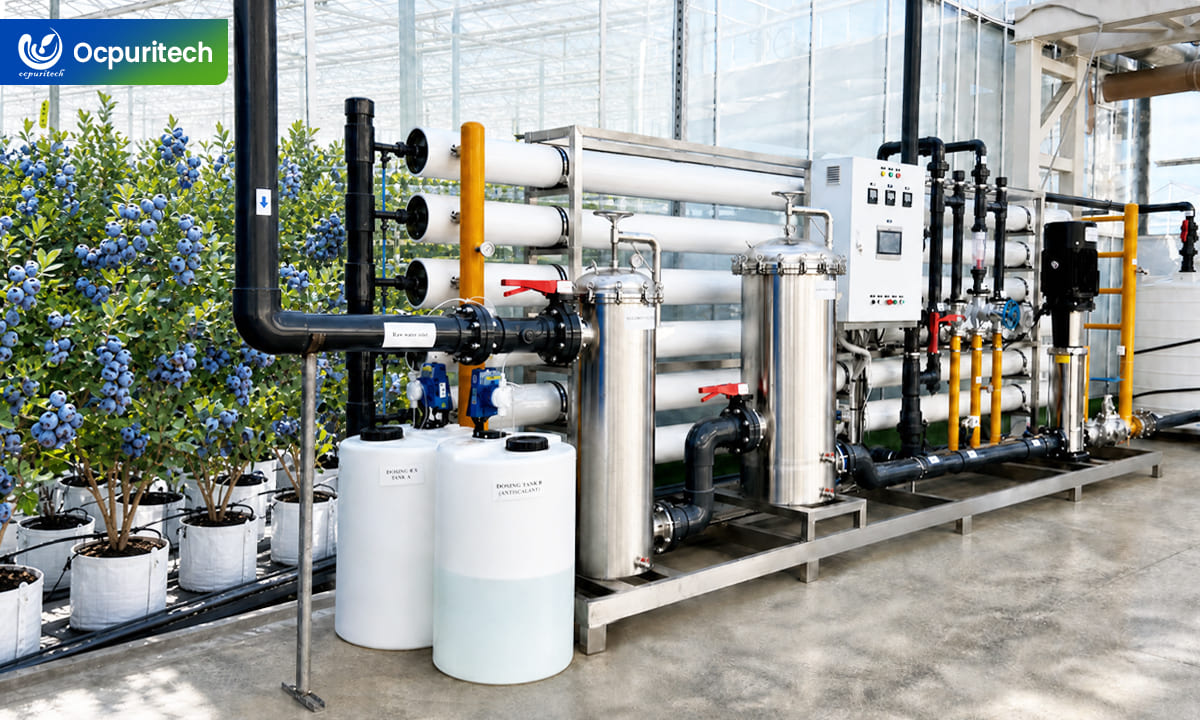
A typical setup separates RO water production from irrigation supply. The RO unit fills a storage tank during the available production hours, while irrigation pumps deliver water according to the farm’s watering schedule.
Tank levels and control settings determine when the RO unit starts and stops. Storage sized around both schedules can help cover irrigation peaks without requiring the RO unit to match the highest instantaneous irrigation flow.
An illustrative arrangement is:
Source water → source-specific pretreatment → RO → product-water storage → validated blending, where appropriate → fertilizer dosing → irrigation distribution.
The actual arrangement depends on existing facilities, available water sources, and control requirements.
Pretreatment depends on the source water. Groundwater may need iron removal, while surface water often requires sediment filtration. Fertilizer mixing should take place downstream of RO to avoid removing nutrients during treatment.
Before purchase, confirm responsibility for tanks, transfer pumps, piping, electrical connections, and level controls. Concentrate handling, cleaning access, and maintenance arrangements should also be resolved during design.
How Do You Size an RO System for a Blueberry Farm?
When sizing RO water treatment systems for blueberry farms, start with peak daily RO product-water demand and realistic production hours. Farm acreage provides context, but cannot determine the required capacity on its own.
Required RO capacity (m³/h) = daily RO product-water demand (m³) ÷ available production hours.
For illustration, a farm requiring 120 m³ of RO product water over 12 production hours needs an average output of 10 m³/h.
Check that all 12 hours are available for production. Cleaning, maintenance, power availability, and source-water restrictions may reduce operating time. If blending is planned, calculate the RO share of final irrigation demand before sizing the equipment.
Check Feedwater and Concentrate Requirements
RO feedwater flow = product-water flow ÷ recovery expressed as a decimal.
At an illustrative 75% recovery:
| Flow |
Calculated Flow Rate |
| RO feedwater |
Approximately 13.3 m³/h |
| RO product water |
10 m³/h |
| Concentrate |
Approximately 3.3 m³/h |
This example excludes pretreatment backwashing and other auxiliary requirements. Actual recovery must be validated against water chemistry and operating conditions.
A well supplying only 10 m³/h cannot continuously support 10 m³/h of RO output under these assumptions. Ask the supplier for a complete water balance.
Storage capacity depends on the production and irrigation schedules. The supplier’s output guarantee should specify the feedwater temperature and composition on which it is based.
If future expansion is planned, include it in the system configuration during sizing. A containerized RO system can simplify equipment integration, but the site still needs suitable utilities, connections, and commissioning.
How Much Does an RO System for a Blueberry Farm Cost?
The cost of RO water treatment systems for blueberry farms depends on source-water quality, product-water targets, required capacity, and what the supplier includes. Two systems with the same hourly output may need different pretreatment, membrane arrangements, and supporting equipment.
| Cost category |
What buyers should check |
| RO equipment |
Guaranteed output conditions, controls, cleaning provisions, and included components |
| Pretreatment |
Treatment duties, backwash needs, chemicals, and replacement media |
| Site integration |
Tanks, pumps, piping, electrical work, delivery, and commissioning inclusions |
| Routine operation |
Electricity, chemicals, consumables, labor, and maintenance assumptions |
| Seasonal ownership |
Shutdown preservation, restart work, spare parts, and concentrate handling |
Compare Quotes Using the Same Assumptions
I compare the feedwater design range, required product-water quality, output, operating schedule, and supply boundaries before comparing prices. A quotation covering only the RO skid cannot be directly compared with a package including pretreatment, installation, and commissioning. Confirm whether commissioning means remote guidance or onsite work, and whether travel and operator training are included.
Higher recovery can reduce feedwater and concentrate volumes for a given output, but may increase scaling constraints. Chemical requirements, cleaning, and concentrate handling must be assessed before assuming it reduces total cost.
Calculate Operating Cost Consistently
Estimated operating cost per m³ = annual operating expenses ÷ annual product-water volume meeting the agreed specification. Define which expenses are included. Keep RO product-water cost separate from final blended-water cost, and assess equipment investment separately from this operating-cost calculation.
For seasonal farms, lower annual utilization spreads fixed operating expenses across fewer cubic meters. Request assumptions for shutdown preservation, restarting, consumable replacement, and maintenance instead of relying solely on a full-load estimate.
Working With a Manufacturer That Understands Both Water and Agriculture
Agronomic advisers establish the crop-management targets. The manufacturer uses the agreed water requirements to select the treatment configuration and define operating limits and monitoring arrangements. That design must also fit the farm’s irrigation schedule, fertilizer program, and onsite operating conditions.
- The feedwater design range, product-water targets, and water balance.
- Defined interfaces with storage, blending, and irrigation facilities.
- Performance guarantees and acceptance methods.
- Maintenance procedures, operator training, and spare-parts arrangements.
Project references are more useful when they identify the water source, treatment objective, capacity, and operating conditions. Equipment photographs alone cannot establish suitability.
Conclusion
To request a proposal for your blueberry farm, send Ocpuritech your project location, source-water analysis, peak daily demand, available production hours, and details of existing storage and irrigation facilities. Our team can review the treatment requirements and prepare a proposal that specifies the equipment included.