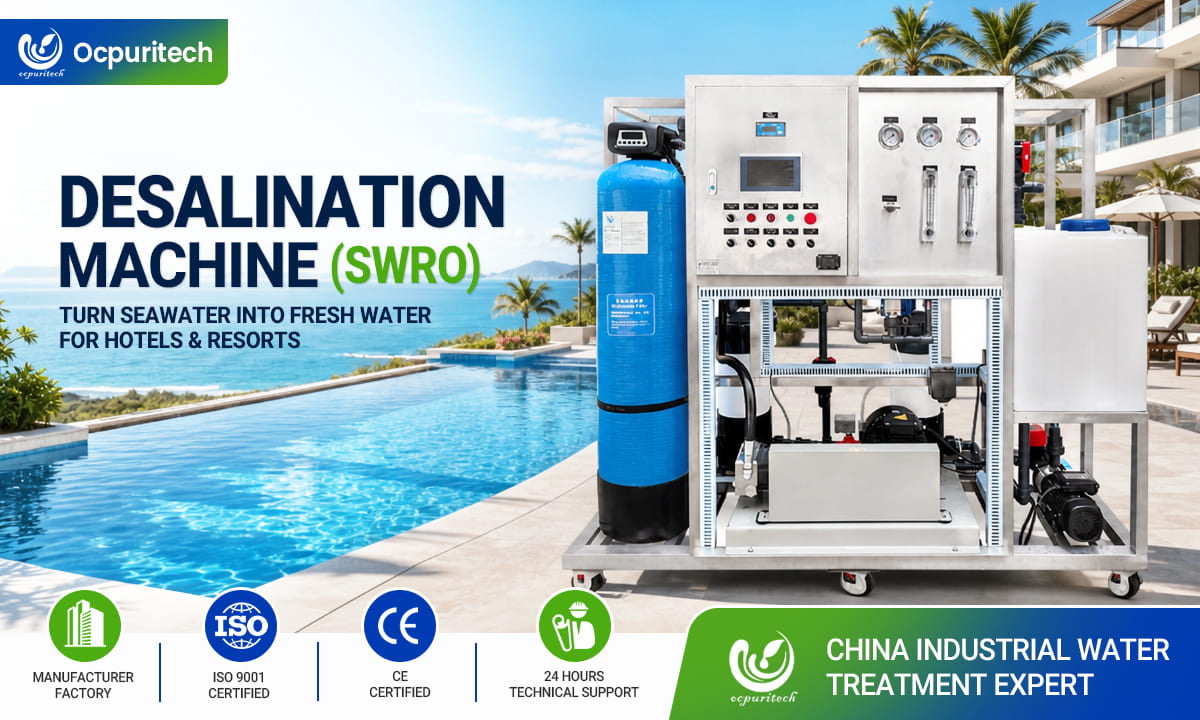
If you’re looking for a desalination machine in the Philippines, the right system depends on your water source, daily production needs, and installation conditions. Whether you’re supplying freshwater to an island resort, remote community, or industrial facility, understanding seawater RO options, costs, and maintenance requirements can help you choose a reliable solution.
Desalination machines use technologies such as reverse osmosis (RO) to remove dissolved salts from seawater or brackish water. Depending on the feedwater quality and intended application, additional treatment may be required to produce water that meets drinking or industrial standards.
Where Are Desalination Machines Used in the Philippines?
The scarcity of drinkable water in the Philippines is a pressing issue, particularly in coastal areas and remote islands. Transporting water is expensive and unsustainable.
Desalination machines cater to various applications, including drinking water for resorts, municipal supplies for remote communities, industrial processes requiring high-quality water, and agricultural projects desiring irrigation solutions. They provide a self-sufficient and dependable source of fresh water for drinking, daily use, or specific industrial processes where local water is scarce or unreliable.
Key Applications and Their Needs
| Client Type |
Primary Focus |
Key Equipment Considerations |
| Island Resorts & Hotels |
Visitors demand consistent potable water |
Stability, low energy use, small footprint, quiet operation, easy maintenance |
| Industrial Use |
Production continuity, water quality |
High output volume, specific water purity, automation, continuous operation |
| Agriculture |
Irrigation water supply where water quality requirements and desalination costs make the project feasible |
Technical compliance, system reliability, long-term performance, project suitability |
| Remote Communities |
Access to safe drinking water |
Affordability, simple operation, durability in harsh conditions, low maintenance |
Types of Desalination Machines and How to Choose the Right Capacity?
SWRO and BWRO systems are classified according to their feedwater salinity, while portable and containerized systems describe equipment configurations. A seawater RO system can also be designed as a compact skid-mounted or containerized unit, depending on the project requirements. The main type is Reverse Osmosis (RO). The type and capacity vary based on project requirements, water needs, and environmental factors. Common types of RO desalination machines:
To choose the right capacity, don’t just look at daily output. Consider your daily water volume, how many hours the machine will run, raw water salinity, and the final water use. We don’t just recommend a standard model. We ask more questions. How many hours will the machine run each day? Is the water source from the sea or from a brackish well? What will the fresh water be used for? Knowing these details helps us recommend the right machine.
- Daily Water Needs: For example, a resort requiring 20 cubic meters/day would need a machine running either 10 hours/day at 2 m³/h or 20 hours/day at 1 m³/h.
- Source Water Salinity: Higher salinity requires more robust RO membranes and pressure.
- Project Purpose: Drinking water demands differ from irrigation or industrial processes.
- Operational Conditions: Evaluate power supply, space availability, and environmental conditions for installation.
How Much Does a Desalination Machine Cost in the Philippines?
The price of a desalination machine for projects in the Philippines depends on production capacity, raw water salinity, system configuration, and automation requirements. Based on our equipment pricing references, smaller desalination systems with capacities of 0.12–2 m³/h typically range from $3,000 to $18,000, while larger systems producing 3–10 m³/h range from $25,000 to $70,000.
These prices are indicative equipment costs, not fixed quotations or average market prices in the Philippines. Final pricing depends on the system specifications and scope of supply. When comparing supplier quotations, Philippine buyers should clarify what is included:
- Pretreatment Integration: Does the quotation include multimedia filters, cartridge filtration, chemical dosing, or other pretreatment equipment required for the raw water conditions?
- Logistics & Taxes: Are shipping, customs clearance, import duties, and inter-island transportation to locations such as Palawan, Cebu, or Siargao included?
- Installation & Commissioning: Does the quotation cover on-site installation guidance, system commissioning, and operator training, or are these services charged separately?
What Affects Desalination Machine Prices?
- System Components: High-pressure pumps, RO membranes, and pretreatment systems significantly affect costs. For example, corrosion-resistant duplex steel pumps increase durability but raise pricing.
- Automation Features: Fully automated systems reduce labor but are more expensive upfront.
- Operational Costs: Turbid surface seawater requires more extensive multi-stage pretreatment (sand filters, ultrafiltration, anti-scalant dosing) compared to cleaner beach-well intake systems. Energy consumption, membrane replacement, and maintenance impact long-term expenses.
- Shipping and Installation: Philippines-based projects should factor in import duties, transport fees, and installation logistics.
Why Total Cost of Ownership Matters
Evaluating Total Cost of Ownership (TCO) helps buyers compare you select a genuinely cost-effective system rather than an undersized or fragile one:
- Energy Consumption (OPEX Driver #1): Energy consumption is a major operating cost for seawater RO systems. High-efficiency pumps and energy recovery devices can help reduce electricity use, but the actual savings depend on system capacity, operating pressure, recovery rate, and daily operating hours. For each project, we evaluate whether the additional equipment cost is justified by the expected energy savings.
- Consumables & Membrane Replacement: Cheap pretreatment leads to premature membrane fouling, forcing membrane replacement every 1–2 years instead of the standard 3–5 years.
- Downtime & Maintenance: Low-grade pump components corrode quickly in tropical marine environments. Unplanned downtime at an island resort or factory results in costly emergency water barging that quickly exceeds any initial equipment savings.
Real Desalination Machine Projects We Delivered in the Philippines
As a specialized manufacturer of seawater reverse osmosis systems, our engineering team has designed and delivered multiple desalination projects across the Philippine archipelago. Below are two representative real-world installations highlighting how we solve site-specific water challenges.
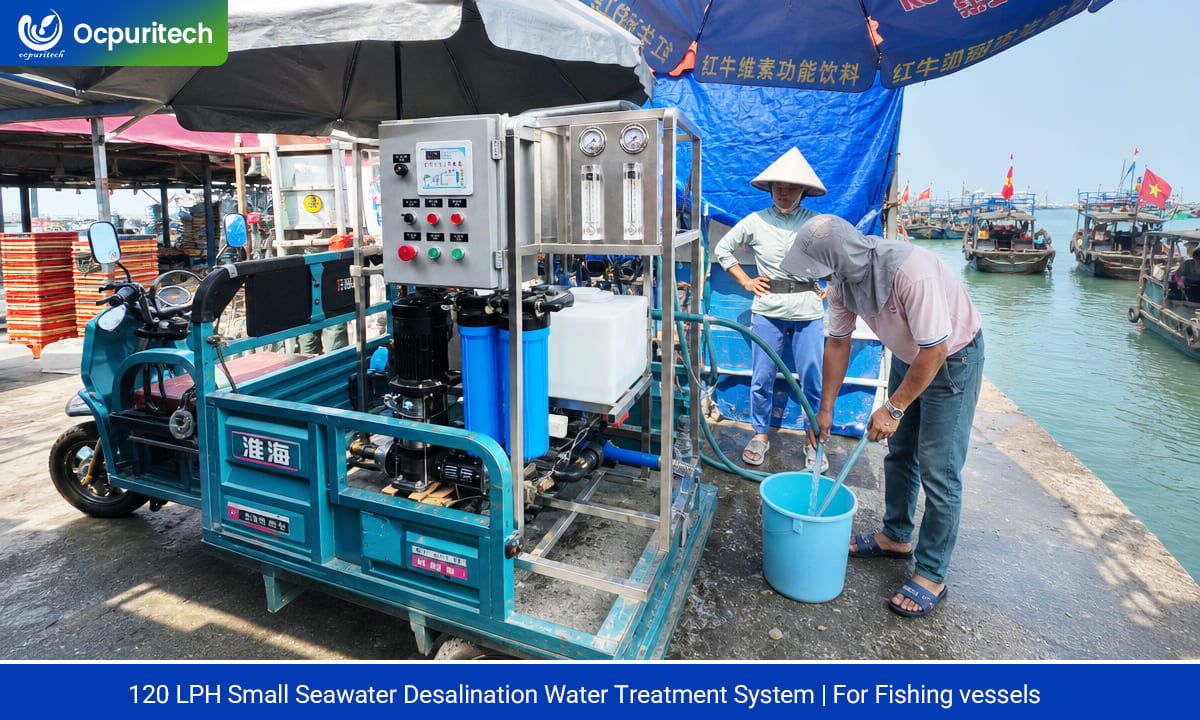
Marine Fishing Vessel Desalination Project in General Santos
- Capacity: 120 L/h (approx. 2.8 m³/day)
- Application: Onboard drinking and crew domestic water for long-range offshore fishing
- Design Feature: Ultra-compact, corrosion-resistant frame for tight engine-room spaces
Project Challenge & Solution:
A commercial tuna longliner operating out of General Santos required an independent freshwater source to extend its fishing voyage duration from 10 days to over 30 days. Space in the vessel’s hull was extremely constrained, and the onboard environment suffered from high engine heat, continuous mechanical vibration, and aggressive sea spray.
We delivered an ultra-compact marine desalination machine engineered with a vertical, skid-mounted frame that fits through standard vessel companionways. Key technical highlights include:
- Corrosion-Resistant Materials: 316L stainless steel high-pressure head and duplex fittings to withstand tropical saltwater corrosion.
- Vibration-Damped Mounting: Heavy-duty anti-vibration footings that isolate pump pulsations from the boat’s hull.
- Simple Operation: One-touch manual start with integrated high/low-pressure safety cutoffs and an online salinity monitor that automatically diverts off-spec water until drinking purity (TDS < 500 ppm) is achieved.
The unit successfully cut the boat’s freshwater tank storage requirements in half, freeing up valuable deadweight capacity for refrigerated catch.
Island Resort & Eco-Hotel Desalination Project in Siargao
- Capacity: 1,000 L/h (1 m³/h, 24 m³/day)
- Application: Potable water, guest rooms, kitchen operations, and infinity pool makeup
- Design Feature: Fully automated PLC/HMI touchscreen control with remote monitoring
Project Challenge & Solution:
An upscale beachfront resort in Siargao faced severe freshwater scarcity during the peak tourist season. Trucked water and island barge deliveries were unreliable, costly, and noisy for guests. The resort needed a quiet, fully automated system that required minimal daily operator intervention.
We engineered and installed a turnkey seawater desalination project for island resorts featuring a 1 m³/h SWRO configuration with complete automation:
- Smart PLC & HMI Touchscreen: Automatically handles system startup, feedwater pre-treatment flushing, chemical anti-scalant dosing, and post-shutdown freshwater purges to prevent membrane scaling.
- Energy-Efficient Pumping: Equipped with a variable frequency drive (VFD) coupled to a high-efficiency plunger pump, reducing startup current surges on the resort’s generator grid.
- Potable Grade Post-Treatment: Includes calcite remineralization and multi-stage UV sterilization, ensuring clean, fresh-tasting drinking water that fully complies with the Philippine National Standards for Drinking Water.
The system runs quietly inside an acoustic equipment shed, providing an uninterrupted 24 m³/day freshwater supply while reducing the resort’s water procurement costs by over 65%.
What to Consider When Buying a Sea Water Desalination Machine?
Before purchasing a desalination machine, check five key specifications: required production capacity (m³/h), raw water salinity (TDS), RO membrane performance, energy consumption (kWh/m³), and maintenance requirements.
For projects in the Philippines, also consider corrosion-resistant materials, available power supply, and local installation conditions. These factors directly affect system reliability, operating costs, and long-term performance.
Key Technical Features to Check
- High-Pressure Pump: This is the heart of the system. We use pumps made from duplex stainless steel because it is highly resistant to corrosion from salt. This means a longer life for the pump and more reliable operation for you.
- RO Membranes: We use high-quality RO membranes with a salt rejection rate of 99.7%. It is important to know that this rating is achieved under specific lab conditions. In a real system, the final water quality will also depend on the seawater’s salinity, temperature, operating pressure, and how well the pretreatment system works. For drinking water, post-treatment and disinfection are usually needed to meet local standards.
- Water Recovery: We can design systems to recover more fresh water from the seawater feed. However, the ideal recovery rate depends on the risk of scaling and the specific design. A great desalination system isn’t just about a high salt rejection rate. It’s a balance of water production, energy use, recovery rate, equipment lifespan, and maintenance costs.
Conclusion
Water desalination is no longer just an alternative option; it has become a fundamental necessity for securing the future of the Philippines’ island economy and coastal communities. As desalination technologies continue to advance in energy efficiency and durability, bringing clean, potable water to off-grid islands and remote facilities is more cost-effective and dependable than ever.
We are committed to delivering rugged, customized seawater RO systems engineered specifically for Philippine installation conditions—ensuring your resort, community, or industrial plant maintains a stable, self-reliant water supply year-round.
Ready to explore a dependable desalination solution for your project? Reach out to our technical team today to discuss your daily capacity needs, water testing results, and site-specific requirements.
Frequently Asked Questions About Desalination Machines
Can Desalination Work for Brackish Water?
What is the Typical Recovery Rate?
Recovery rates average 30-50% for seawater systems but depend on water salinity.
How Often do Desalination RO Membranes Need Replacement?
Typically every 2-5 years, depending on usage and maintenance.
Are there Sustainable Options for Energy Use?
How Long Does it Take to Get a Desalination Machine?
Our standard production time is about 25 days. The final lead time will depend on the specific configuration of your machine and when the order is confirmed. We always make sure the delivery schedule is clear before you commit.
To give you the most accurate and helpful quote, we need to understand your project. The most important questions we ask are:
- Where is your project located?
- How much fresh water do you need per day?
- Is your raw water from the sea or a brackish well?
- What will the water be used for (drinking, hotel, industrial)?
- What are the power supply and installation conditions at your site?
With this information, we can recommend the right equipment and provide a price that makes sense for your project.