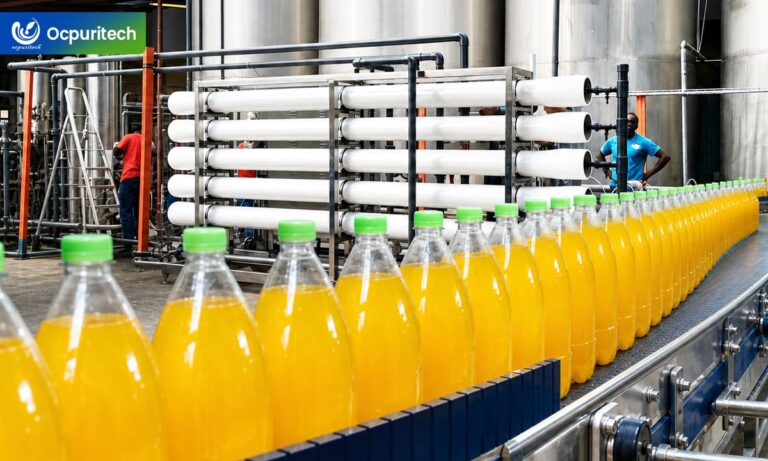
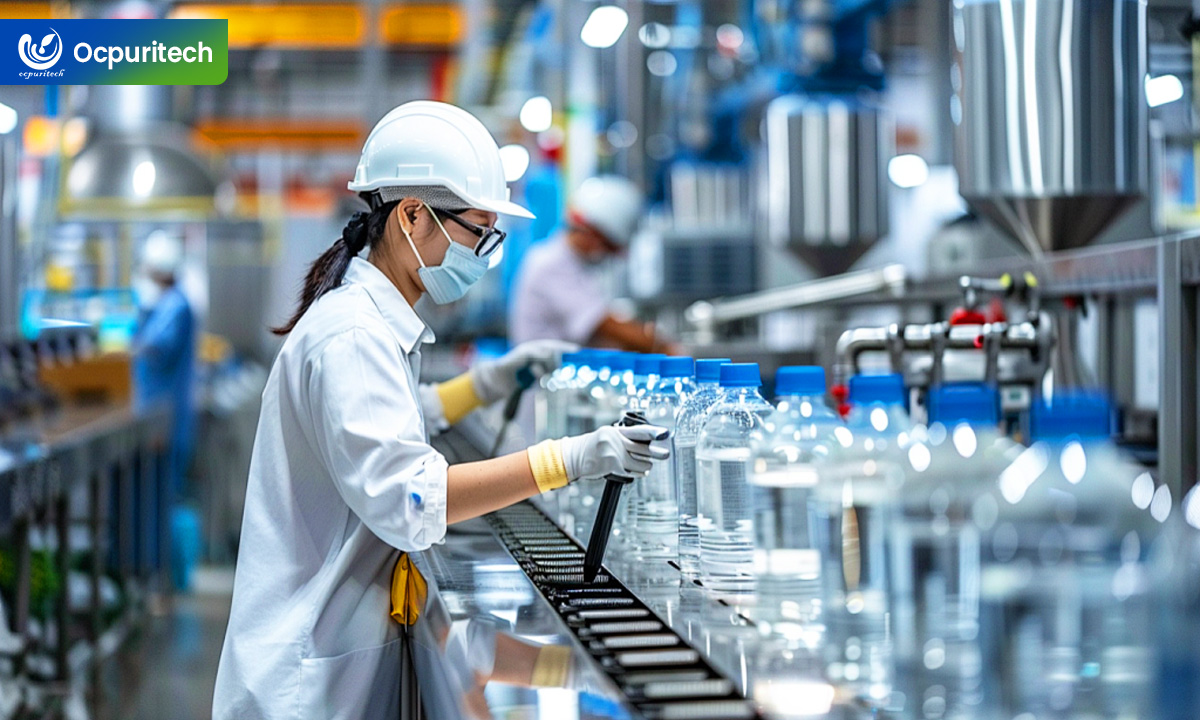
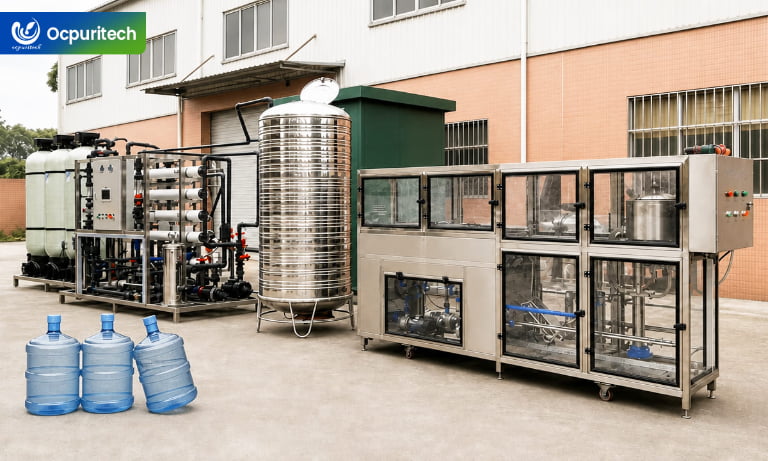
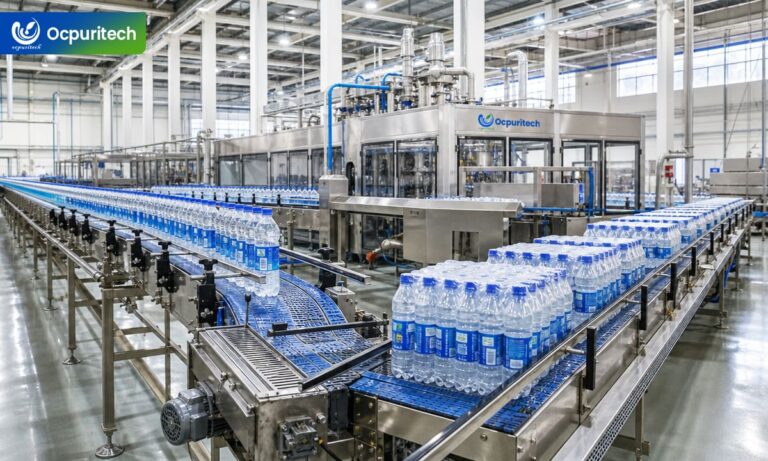
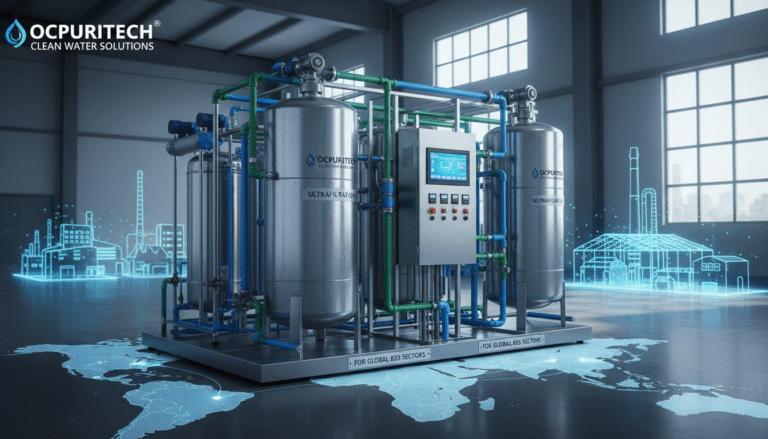
The bottled water production process typically includes raw water treatment, water purification and disinfection, PET bottle blowing, bottle rinsing, filling, capping, labeling, coding, and final packaging.
The exact production process depends on the raw water source, required finished-water quality, bottle size, production capacity, and level of automation. For example, a plant using high-TDS well water may require reverse osmosis, while high-quality spring water may need a different treatment configuration if minerals are to be retained.
In this guide, I’ll explain each stage of the bottled water manufacturing process, the equipment required, how to determine production capacity, and the main factors that affect plant setup and cost.
What Is the Bottled Water Production Process?
The bottled water production process starts with treating the raw water and ends with filling, labeling, and packaging the finished bottles. A typical production line follows these main stages:
Raw Water → Pretreatment → RO/UF Purification → UV/Ozone Disinfection → Purified Water Tank → PET Bottle Blowing → Bottle Rinsing → Filling → Capping → Labeling → Date Coding → Packaging → Finished Product
The exact process is not the same for every bottled water plant. The water treatment stage depends mainly on the raw water source and the required finished-water quality, while the bottling section is determined by bottle size, target bottles per hour (BPH), and the required level of automation.
For example, well water with high TDS may require reverse osmosis, while high-quality spring water may use ultrafiltration when mineral retention is required. This is why I recommend confirming the raw water analysis before selecting the water treatment system.
Step-by-Step Bottled Water Manufacturing Process
Step 1: Raw Water Treatment and Purification
Firstly, the foundation of quality bottled water lies in stringent water treatment and purification. The water used in bottled products typically undergoes rigorous purification processes to remove contaminants, bacteria, chemicals, and particulates. Depending on the raw water conditions and required finished-water quality, the treatment process may combine pretreatment, membrane filtration, and final disinfection. Some of the common purification methods include:
Common Water Treatment Methods
Pre-filtration: Often using quartz sand or activated carbon, filtration removes large particles, suspended solids, and organic material, thereby reducing the turbidity of water.
Microfiltration and Ultrafiltration: MF and UF membranes can remove fine suspended particles, colloids, and microorganisms, depending on the selected membrane pore size and system design.
Reverse Osmosis (RO): After suitable pretreatment, RO membranes remove a high proportion of dissolved salts and other remaining contaminants from the feed water. Pretreatment should be selected according to raw water conditions to control turbidity, hardness, iron, chlorine, and other substances that may affect membrane performance.
Ozonation and UV Treatment: UV and ozone can be used as final disinfection steps to control microorganisms in treated water. The appropriate disinfection method and operating conditions depend on the required finished-water standard and system design.
Therefore, the choice of purification method typically depends on the water source, such as municipal water, well water, or natural spring water, as well as the required finished-water quality. For example, when producing mineral water from high-quality spring water and mineral retention is required, UF may be considered. For raw water with high dissolved solids, RO is commonly used after suitable pretreatment.
| Raw Water / Product Goal |
Typical Treatment Direction |
| Municipal tap water |
Pretreatment + RO/UF as required + disinfection |
| Well water |
Pretreatment based on hardness, iron, manganese and TDS + RO if required |
| High-TDS groundwater |
Pretreatment + RO + disinfection |
| High-quality spring water |
UF or other suitable filtration + disinfection where mineral retention is required |
| Purified bottled water |
RO commonly used + final disinfection |
In my experience, the water treatment system should never be selected from production capacity alone. I first look at the raw water analysis and the required finished-water standard. These two factors determine whether RO, UF, softening, iron removal, or additional pretreatment is actually necessary.

Step 2: PET Bottle Blowing
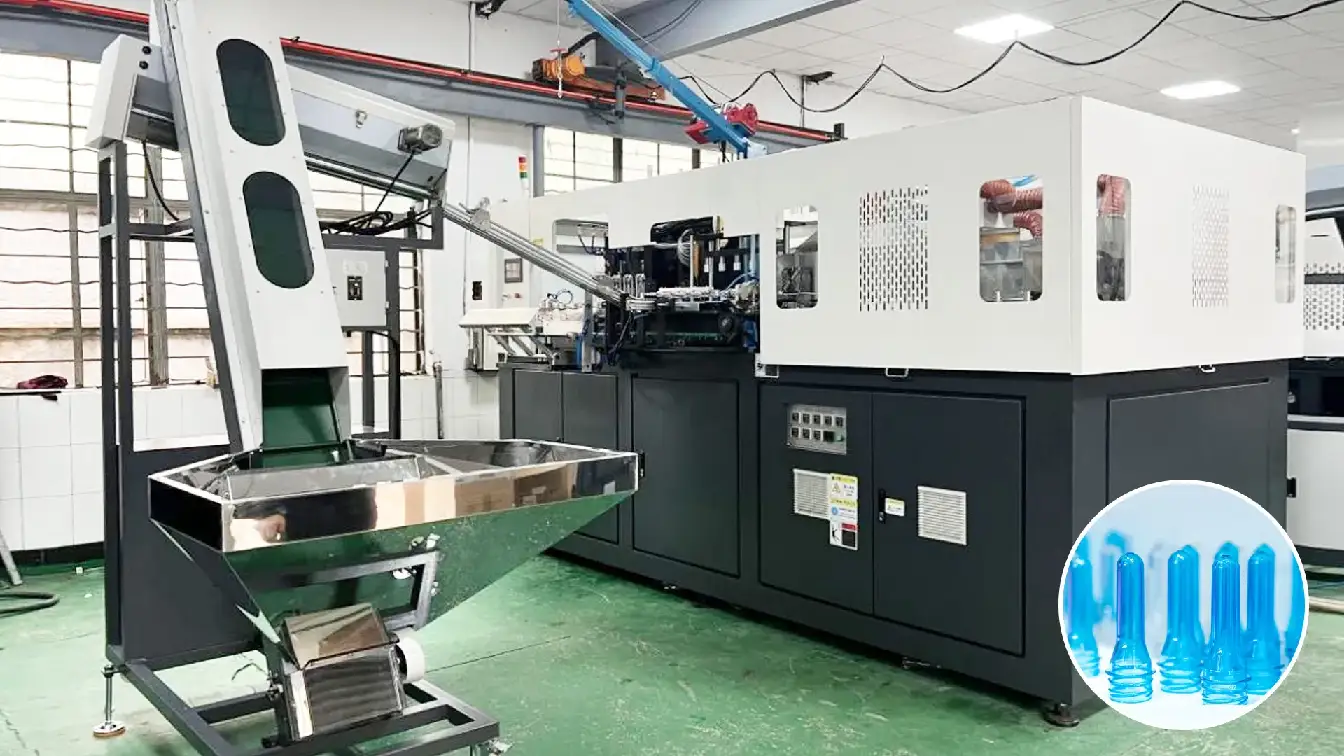
Preform Production: For PET (Polyethylene Terephthalate) bottles, the preforms are first heated and then placed into a blow molding machine, where they are inflated into molds using compressed air, forming the desired bottle shape while ensuring consistency in wall thickness and strength.
Cost Savings: Preform weight, bottle design, and PET consumption directly affect packaging cost. Lightweight preforms can reduce material use, but the finished bottle still needs sufficient strength for filling, handling, storage, and transportation.
Step 3: Bottle Rinsing, Filling and Capping
This stage is critical for product hygiene and integrity. Modern production lines use 3-in-1 filling machines that rinse, fill, and cap bottles in a continuous operation. Precise filling volumes and secure cap application are important for stable production and product hygiene.
- Bottle Rinsing: Before filling, the rinsing station cleans bottles with sterilized water or air to remove any dust, debris or contaminants. This ensures that the bottles are sanitary and ready for the filling process, maintaining water quality and safety standards.
- Bottle Filling: The treated water is dispensed into the cleaned bottles using an automated filling machine. The filling process is often done in a controlled environment to prevent contamination.
- Bottle Capping: After filling, the bottles are immediately capped using automated capping machines. Operators sterilize caps before use to maintain hygiene standards.
In practice, the filling machine should be matched to the bottle size, target bottles per hour (BPH), cap type, and required automation level. The upstream bottle blowing machine and downstream labeling and packaging equipment should also be sized to match the filling speed and avoid production bottlenecks.

Step 4: Labeling, Coding and Packaging
After filling and capping, bottles proceed to labeling and packaging. Automated labeling machines ensure accurate placement and minimal material waste, applying branded labels that include essential product details, certifications, and expiration dates. Depending on the product line, this process may involve heat-shrink sleeves or pressure-sensitive adhesive stickers.
The process is often followed by shrink-wrapping into multi-packs or boxing, and finally palletizing for shipment. Effective packaging is critical; it not only ensures the bottles are protected during transportation and storage but also serves as a crucial marketing tool.

What Equipment Is Used in Bottled Water Production?
A complete bottled water production process requires more than a filling machine. The equipment normally covers water treatment, bottle production, rinsing and filling, labeling, coding, and final packaging. The exact configuration depends on the raw water quality, bottle size, target production capacity, and required level of automation.
| Production Stage |
Main Equipment |
Function |
| Water treatment |
Pretreatment, RO/UF system, UV or ozone |
Treat raw water to the required finished-water quality |
| Bottle production |
PET bottle blowing machine |
Heat and blow PET preforms into finished bottles |
| Rinsing, filling and capping |
3-in-1 rinser-filler-capper |
Rinse bottles, fill treated water, and apply caps |
| Coding |
Inkjet or laser coder |
Print production dates, batch numbers, or other required information |
| Labeling |
Labeling machine |
Apply shrink-sleeve or pressure-sensitive labels |
| Packaging |
Shrink wrapper or cartoning machine |
Pack finished bottles for storage and transportation |
I recommend selecting the equipment as one connected production system rather than as separate machines. For example, a 6,000 BPH filling machine does not provide a practical 6,000 BPH line if the bottle blowing or packaging equipment cannot keep pace.
For buyers planning a complete bottling project, our bottled water production line solutions can be configured according to bottle size, target BPH, raw water conditions, and automation requirements.
How to Choose the Right Bottled Water Production Capacity
Bottled water production capacity should be determined by the bottle size, target bottles per hour (BPH), daily operating hours, and required finished-water output.
A simple starting calculation is:
Finished Water Demand (L/H) = Bottle Volume (L) × Bottles per Hour (BPH)
For example, if you plan to produce 500 mL bottles at 3,000 BPH:
0.5 L × 3,000 BPH = 1,500 L/H of finished bottled water
However, this does not mean that a 1,500 L/H raw-water treatment system is automatically sufficient. The actual water treatment capacity should also account for RO recovery, bottle rinsing water, system flushing, CIP requirements, production losses, peak demand, and possible future expansion.
Capacity also needs to be matched across the complete production line. Match the bottle blowing machine, rinser-filler-capper, labeling machine, and packaging equipment to the same production target. Otherwise, one undersized section can become the bottleneck of the entire line.
In practice, I normally confirm both target BPH and daily operating hours before sizing the water treatment and bottling equipment. This provides a more realistic basis for equipment selection than looking at the filling-machine capacity alone.
How to Plan a Bottled Water Production Plant
Planning a bottled water production plant starts with the production requirements rather than simply fitting machines into the available factory space.
Before finalizing the plant layout, I normally confirm the raw water source, bottle size, target BPH, daily operating hours, finished-water requirements, equipment configuration, and available factory space.
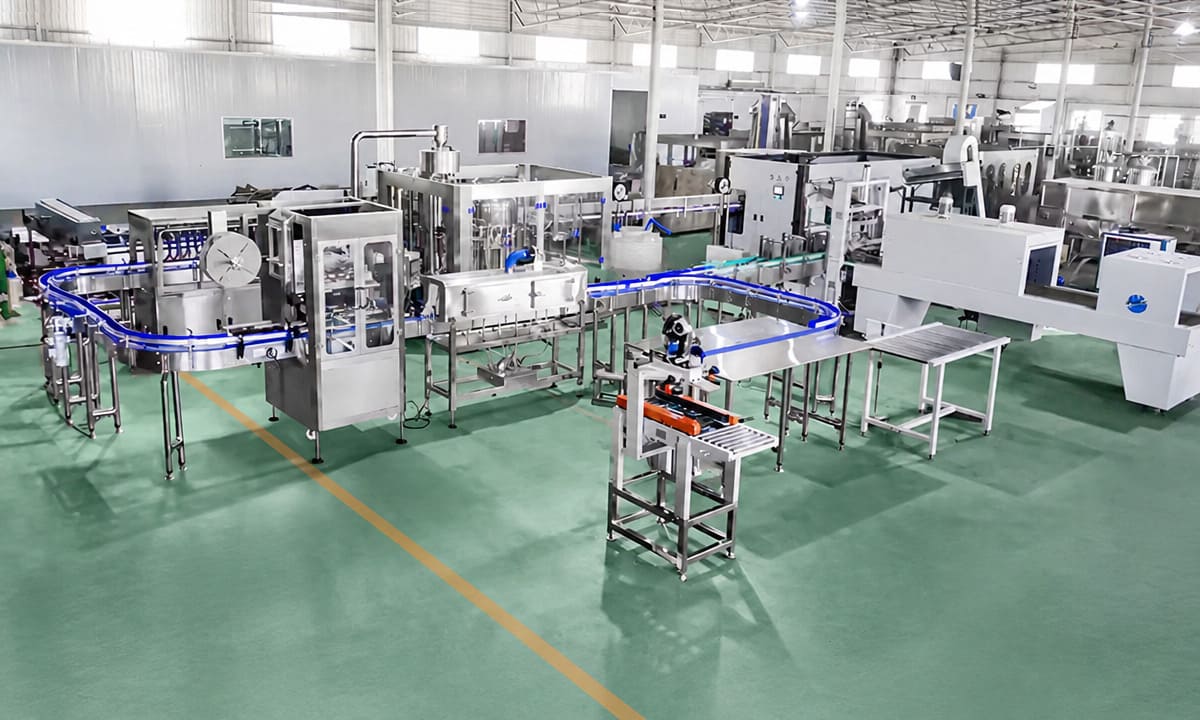
A practical layout should allow water treatment, bottle production, filling, labeling, packaging, and finished-product storage to operate as one continuous process. At the same time, sufficient space should be reserved for operators, maintenance, material handling, drainage, and equipment access.
Raw Water Supply and Water Treatment Area
The water treatment area should be planned according to the raw water source and laboratory analysis. Pretreatment, RO or UF, disinfection, treated-water storage, pumps, and CIP equipment should have sufficient operating and maintenance space.
The treated-water section should also be positioned to provide a practical connection to the filling area while minimizing unnecessary piping.
Bottle Blowing, Filling and Packaging Areas
Arrange the bottle blowing machine, 3-in-1 rinser-filler-capper, labeling machine, coding equipment, and packaging system according to the production flow.
A typical layout follows:
Bottle Blowing → Bottle Conveying → Rinsing/Filling/Capping → Labeling → Coding → Packaging → Finished Product Storage
The filling area requires particular attention to hygiene and contamination control. The exact zoning and sanitary requirements should follow the applicable regulations and finished-product requirements in the destination market.
Utilities and Factory Infrastructure
The production machines are only one part of the plant. Supporting utilities also need to be considered during the layout stage. Typical requirements include:
- Electrical power and the correct local voltage and frequency
- Compressed air for bottle blowing and pneumatic equipment
- Raw-water and treated-water storage
- Floor drainage and wastewater discharge
- Ventilation and suitable environmental conditions
- Space for operators and routine maintenance
- Access for replacing filters, membranes, pumps, and other components
- Storage for PET preforms, caps, labels, packaging materials, and finished products
In my experience, equipment footprint alone should not be used to determine the required factory space. A layout may fit every machine on paper but still cause problems if there is not enough room for maintenance, material movement, or finished-product storage.
Regulatory and Hygiene Requirements
The plant design should also take into account the drinking-water, food-safety, hygiene, labeling, and food-contact requirements of the destination market.
These requirements vary by country and product type. Therefore, confirm the applicable local regulations before finalizing the equipment configuration and plant layout.
What Determines Bottled Water Production Cost?
There is no single fixed cost for a bottled water production plant because the equipment configuration can vary significantly from one project to another.
In my experience, the main cost drivers are the raw water treatment requirements, production capacity, bottle size, level of automation, and scope of equipment included in the production line. Two plants with the same target BPH can therefore require very different investments if their raw water conditions, bottle formats, or equipment configurations are different.
| Cost Factor |
Why It Affects Cost |
| Raw water quality |
Determines the required pretreatment, RO/UF, softening, iron removal, and disinfection configuration |
| Water treatment capacity (L/H) |
Affects the size of filters, membranes, pumps, tanks, and other water treatment components |
| Bottle size and target BPH |
Determines filling-machine capacity and influences the required speed of downstream equipment |
| Automation level |
Changes the equipment configuration, control system, and amount of manual handling required |
| Bottle blowing |
Adding PET bottle blowing requires a blowing machine, air compressor, and related auxiliary equipment |
| Labeling and packaging |
Different labeling, shrink-wrapping, cartoning, and other packaging methods require different downstream equipment |
| Supporting utilities |
Air compressors, pumps, tanks, conveyors, and CIP equipment can add to the overall project scope |
| Installation and shipping |
Costs vary according to the installation requirements, project location, scope of supply, and shipping method |
When comparing quotations, I recommend looking at the complete scope of supply rather than the equipment price alone. For example, one quotation may include water treatment, bottle blowing, filling, labeling, coding, conveyors, and packaging, while another may cover only water treatment and filling. The two prices are therefore not directly comparable.
For an accurate quotation, I normally need the following project information:
- Raw water source
- Raw water analysis, if available
- Bottle size
- Target bottles per hour (BPH)
- Operating hours per day
- Required finished-water quality
- Required level of automation
- Local voltage and frequency
With this information, the water treatment capacity and bottling equipment can be sized around the actual production requirements rather than using a standard configuration.
Planning a Bottled Water Production Plant?
Ocpuritech designs and manufactures customized water treatment and bottled water production systems for different raw water conditions, bottle sizes, and production capacities.
If you are planning a new bottled water plant or upgrading an existing line, send us your raw water source or water analysis, bottle size, target bottles per hour (BPH), daily operating hours, and required finished-water quality. Based on these project details, we can help configure the water treatment, bottle blowing, filling, labeling, and packaging equipment to match your actual production requirements.
Bottled Water Production Process FAQs
Q1: What is the bottled water production process?
The bottled water production process typically includes raw water treatment, purification and disinfection, PET bottle blowing, bottle rinsing, filling, capping, labeling, coding, and final packaging.
The exact process depends on the raw water source, required finished-water quality, bottle size, production capacity, and level of automation. For example, high-TDS groundwater may require RO treatment, while high-quality spring water may use a different treatment process when mineral retention is required.
Q2: What equipment is needed to produce bottled water?
A complete bottled water production system typically includes water treatment equipment, a PET bottle blowing machine, a 3-in-1 rinser-filler-capper, labeling and coding equipment, conveyors, and final packaging equipment.
The machines should be selected as one connected system. Their capacities need to match so that bottle blowing, filling, labeling, and packaging do not create production bottlenecks.
Q3: Is RO always required for bottled water production?
No. Reverse osmosis is not required for every bottled water project.
The appropriate treatment process depends primarily on the raw water analysis and required finished-water quality. RO is commonly used when dissolved salts and other contaminants need to be significantly reduced. In other cases, such as suitable high-quality spring water where mineral retention is required, UF or another treatment configuration may be more appropriate.
I recommend reviewing the raw water analysis before deciding between RO, UF, or other treatment technologies.
Q4: How do I calculate the required bottled water production capacity?
A simple starting point is: Finished Water Demand (L/H) = Bottle Volume (L) × Bottles per Hour (BPH)
For example, 500 mL bottles at 3,000 BPH require approximately 1,500 L/H of finished bottled water. The actual system capacity should also account for water treatment recovery, rinsing, cleaning, operating hours, and production losses.
Q5: How much does a bottled water production line cost?
There is no single fixed price because the cost depends on the raw water treatment requirements, production capacity, bottle size, target BPH, automation level, and scope of equipment.
For example, a complete line including water treatment, PET bottle blowing, filling, labeling, coding, conveyors, and packaging equipment will have a different investment level from a system that includes only water treatment and filling.
Installation, commissioning, auxiliary equipment, and shipping can also affect the total project cost.
Before designing a bottled water plant, the supplier normally needs the raw water source or analysis, bottle size, target BPH, daily operating hours, required finished-water quality, automation level, local power supply, and available factory space. These details are used to size the water treatment and bottling equipment and prepare the plant layout.
Need a Bottled Water Production Solution?
Send us your raw water analysis, bottle size, and target BPH to get a customized system configuration for your project.