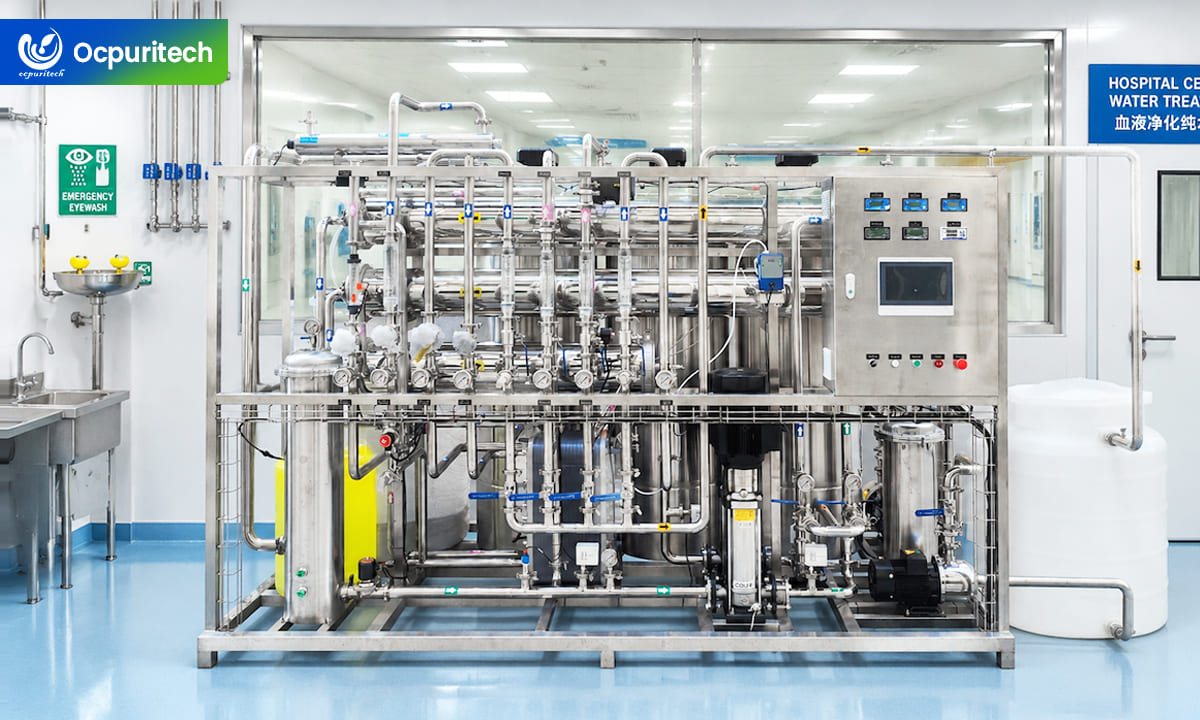
The best water treatment systems for hospitals depend on the intended use, feedwater quality and equipment specifications. Reverse osmosis (RO) reduces dissolved salts; Deionization or EDI provides further ionic polishing where required. Ultrafiltration (UF), activated carbon, softening and UV serve different filtration, pretreatment and disinfection functions.
This guide compares common hospital water purification systems and explains how to assess treatment options, capacity and operating costs. Start with a water analysis and the specifications of the equipment being supplied.
What Water Quality Do Hospitals Need?
Hospitals use water for drinking, medical-device cleaning, laboratory testing and dialysis. Each application has different water quality requirements. Water suitable for drinking may still need further treatment before it can supply specialized medical equipment.
For instrument cleaning and rinsing, excessive hardness can leave mineral deposits and affect cleaning performance. Laboratory analyzers need control of ions, particles and other impurities that could interfere with testing. Dialysis water has specific requirements for chemical contaminants, bacteria and endotoxins. These differences determine what treatment is needed.
When I assess a hospital water treatment project, I start with the intended use and the equipment manufacturer’s water specifications. Comparing these requirements with a source-water analysis helps identify which contaminants need to be reduced and which treatment technologies are appropriate.
Common Water Treatment Systems for Hospitals
Several water treatment systems are commonly employed in hospitals to meet the stringent quality standards required. Here are the main water purification systems:
Reverse Osmosis (RO) Systems – The Core Purifier
Reverse osmosis systems are one of the most prevalent water treatment solutions in hospitals. RO uses a membrane to reduce dissolved salts and many other contaminants. I would assess Reverse osmosis when equipment requires lower conductivity than the feedwater provides. Predicted output and water quality should be checked at the proposed feedwater conditions and temperature.
Reverse osmosis can form part of a dedicated purification system. Dialysis water and Water for Injection have separate specifications and verification requirements. Reverse osmosis treatment alone does not establish suitability for every medical application. Regular maintenance, including membrane cleaning and replacement, is necessary to ensure optimal performance.
Ultrafiltration (UF) Systems for Particles and Suitable Pretreatment
The pore size of the membranes in the ultrafiltration systems is usually between 0.01microns and 0.1 microns, which can effectively filter suspended particles, colloids and some microorganisms. I often use ultrafiltration as a cost-effective pretreatment for an reverse osmosis system, especially if the source water has a high particle load.
This protects the more sensitive and expensive reverse osmosis membranes, extending their life. However, it’s important to remember that UF does not significantly reduce dissolved salts. Meanwhile, the membranes in ultrafiltration systems can become blocked by suspended solids, necessitating periodic backwashing and cleaning.
Deionization (DI) and Electrodeionization (EDI) Systems
Deionization and EDI systems are ideal for producing ultra-pure water for sensitive applications like laboratory analysis. DI systems use cation and anion exchange resins to remove ions from water, producing high-purity water. Electrodeionization combines an electric field with ion exchange resins and is often used for further polishing RO water.
The decision to incorporate deionization (DI) or Electrodeionization (EDI) depends on the ion level requirements of the end-use equipment.
Activated Carbon Filtration Systems and Water Softener
Activated carbon can reduce free chlorine, taste- and odor-causing compounds, and selected organic contaminants.They also improve water taste, ensuring patients receive high-quality drinking water. Water softener systems address hardness caused by calcium and magnesium, helping to prevent scaling risks in equipment.
UV Disinfection Systems
UV sterilization is often the final guard. Ultraviolet disinfection can support microbial control when operated within specified conditions. Its effectiveness depends on factors such as flow, UV transmittance and equipment performance. It does not provide a disinfectant residual to protect downstream pipework.
UV location, monitoring and maintenance should follow the system design. Storage and distribution require their own contamination-control measures.
Which System Fits Each Hospital Application?
Choosing the appropriate water treatment system for a hospital involves several factors. This includes understanding water quality requirements, usage scenarios, budget, and maintenance complexity.
For general drinking and building supply, I assess the applicable drinking water standards, the quality of source water, and existing supply management measures. For medical equipment cleaning and rinsing, water requirements can vary between initial cleaning and final rinsing. It’s crucial to evaluate the necessary treatment levels based on the specifications of the equipment.
For laboratory analyses, the focus shifts to ionic, particulate, and microbial indicators. I often start by reviewing the incoming water requirements from equipment manufacturers. In cases of dialysis, I ensure that water quality standards specific to dialysis are met with tailored treatment solutions.
The options below are starting points for engineering review. Final selection must follow applicable requirements, equipment instructions and the proposed feedwater conditions.
| Application |
Treatment Options to Assess |
Main Selection Basis |
| Drinking and building water |
Source-specific treatment and supply-management measures |
Applicable drinking-water requirements and feedwater quality |
| Laboratory diagnostics |
RO with DI, EDI or other polishing where required |
Analyzer manufacturer’s water specifications |
| Hemodialysis |
Dedicated dialysis water-treatment and distribution system |
Applicable chemical and microbiological requirements, including endotoxin control |
| Medical-device washing and rinsing |
Softener, RO or additional treatment as required |
Processing stage and equipment instructions |
| General cleaning |
Treatment appropriate to the intended use |
Source water and cleaning requirements |
Medical-device cleaning, disinfection and sterilization involve different requirements. A water-treatment combination cannot, by itself, establish that medical equipment is sterile.
How Do Hospital Water Filtration Systems Work Together?
For a dedicated equipment-water supply, a possible arrangement includes source-specific pretreatment and cartridge filtration before reverse osmosis. Deionization or electrodeionization can follow where further ionic removal is required. Storage, distribution and application-specific microbial controls must also be addressed.
Municipal water may need dechlorination before chlorine-sensitive reverse osmosis membranes. Groundwater may require assessment for hardness, iron, manganese or salinity. Ultrafiltration is an option where particle removal is justified; it is not a mandatory stage in every system.
Match the sequence to the equipment-water branch and the hospital’s wider water-management plan. Confirm how the design will manage storage turnover, stagnation and water quality at the relevant use points.
What Maintenance and Operating Costs Should You Expect?
Maintenance should be a key component when selecting any water treatment system. Each component, such as filters, membranes, and UV equipment, has its own maintenance requirements. Before purchasing, it is essential to create a flow that is easy to understand and maintain. The criteria for water quality, replacement timelines for consumables, and procedures for cleaning should be clearly outlined.
Cost considerations extend beyond initial equipment purchase prices. It also includes factors like source water quality, discharge, energy, consumables, and labor for maintenance. If additional storage or monitoring systems are necessary, those costs should also be factored into the overall budget.
Compare quotations using the same feedwater assumptions, required output and supply scope. Confirm whether pretreatment, storage tanks, delivery pumps, monitoring, installation and commissioning are included.
Conclusion
In summary, the water treatment systems used in hospitals incorporate various technologies, such as reverse osmosis, ultrafiltration, deionization, activated carbon filtering, and UV disinfection. Each system plays a vital role in maintaining safe and pure water for medical purposes. By effectively configuring and maintaining these systems, hospitals can ensure the safety of their medical processes and protect patient health.
Planning a hospital water treatment project? Send Ocpuritech your water analysis, equipment water specifications and required capacity to discuss a suitable configuration.