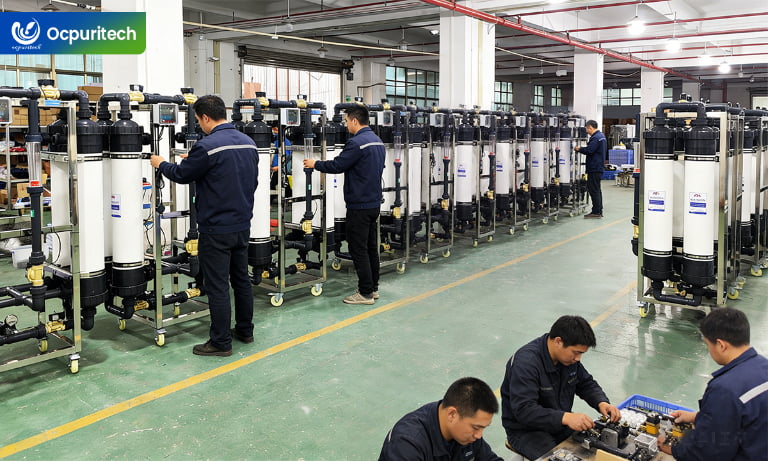
Industrial ultrafiltration systems are worth considering when variable turbidity, suspended solids or colloids compromise process water or RO pretreatment. They do not desalinate water or reliably remove hardness. Whether your facility needs UF depends on the feed-water analysis, required net output and final water-quality targets.
Ultrafiltration (UF) is a powerful tool in our toolbox, but its success depends entirely on applying it to the right problem. It’s not a magic bullet for every water issue. Let’s walk through how I determine if a UF system is the correct and most cost-effective solution for an industrial facility.
What Can Industrial Ultrafiltration Systems Remove?
When I assess if a UF ultrafiltration system is a good fit, I first separate the water quality issues into two main groups: particles that need to be physically blocked, and dissolved substances that require a different kind of treatment. UF is designed to handle the first group. If your primary goal is to lower turbidity and reduce the particle load on downstream equipment, then UF is certainly worth evaluating.
However, clear water doesn’t mean it’s pure. If your problem is high Total Dissolved Solids (TDS), hardness that exceeds process limits, or dissolved contaminants like nitrates, UF alone won’t solve it. These issues require processes like desalination (RO), water softening, or other targeted treatments. Simply adding more UF membrane area won’t make up for this capability gap. For microbial control, I also verify the specific membrane’s validation data and how its integrity will be tested on-site.
| Contaminant Type |
Does UF Remove It? |
My Notes |
| Suspended Solids & Silt |
✅ |
Excellent for reducing turbidity and SDI. |
| Colloids |
✅ |
A key strength of UF, protecting RO membranes. |
| Bacteria & Algae |
✅ |
UF provides a physical barrier against most microorganisms. |
| Viruses |
Partially |
Confirm validated removal performance for the selected membrane and the required integrity monitoring. |
| Dissolved Salts (TDS) |
❌ |
RO is commonly used for desalination. NF suitability depends on the ions present and the required rejection. |
| Hardness (Calcium, Magnesium) |
❌ |
Requires a water softener or RO. |
| Dissolved Organics |
Membrane-dependent |
Some large organic molecules may be removed, but not smaller ones. |
When Is UF Worth Considering for Your Facility?
If a client tells me their RO system needs constant cleaning, I first look at the performance logs and the type of fouling. Fouling from particles and colloids points toward a different solution than scaling caused by hardness or silica. Identifying the main cause is the first step to knowing if adding a UF system will actually fix the problem.
I generally use this line of thought for a quick initial assessment:
| On-site Situation |
My Initial Judgment |
Next Steps for Confirmation |
| River/lake water with seasonal turbidity spikes |
UF and front-end pre-treatment are worth evaluating. |
Check turbidity, solids, algae, and organic levels during the rainy season. |
| Unstable particle control for RO feed water |
Ultrafiltration is a suitable option to investigate. |
Confirm SDI, turbidity, and the true cause of membrane fouling. |
| Stable municipal water, current system runs fine |
Adding UF depends on stricter process requirements. |
Define target water quality, microbial needs, and current filter performance. |
| Main problem is high salinity or hardness |
Need a process targeting dissolved substances. |
Get a full ion analysis, define the end-use, and set treatment goals. |
| Reclaimed water contains oil or high organics |
Must confirm contaminant form and membrane suitability. |
Check upstream treatment effectiveness; a pilot test may be necessary. |
I always weigh the investment in industrial ultrafiltration systems against the current costs of filter cartridge consumption, Reverse osmosis cleaning chemicals, downtime, and production instability. The investment is justified by the real improvements it brings to your operation and the resources needed to maintain it.
Which Industrial Applications Benefit from UF?
When discussing industrial uses, I break down the industry name into specific water-use points. A single factory might need different treatment solutions for its process water, cleaning water, and boiler feedwater. Just knowing a client is in the food or power industry isn’t enough to place the industrial ultrafiltration systems.
- Food & Beverage Plants: I first confirm if the water is for product ingredients, cleaning, or other uses. Then, I check the requirements for particles, microbes, and chemical indicators to decide if RO, disinfection, or other steps are needed after the UF.
- Boiler Feedwater & Industrial Utilities: My focus here is on whether UF can improve the feed conditions for the downstream RO or deionization systems. I also separately check the hardness, silica, and salinity control requirements.
- Industrial Water Reuse: I work backward from the reuse application. Water for rinsing, cooling, or re-entering a production line has different quality and stability requirements. Making the water clear is just one part of the puzzle.
Project Example: A 6 m³/h Ultrafiltration Water Treatment System in Sri Lanka
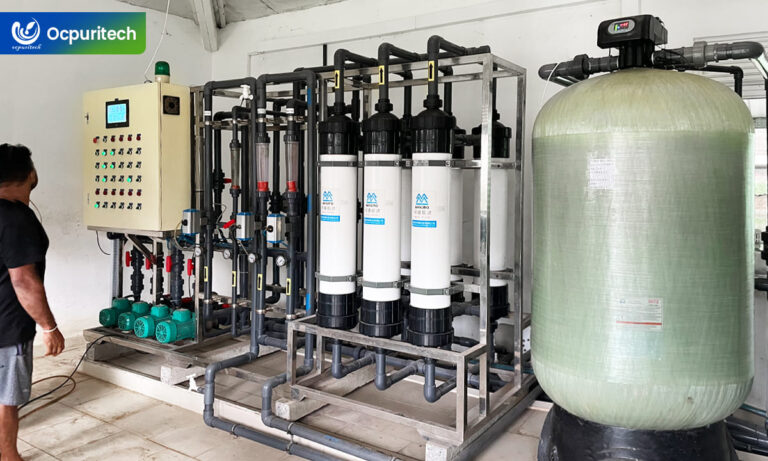
Our Sri Lanka poultry and swine drinking-water project, we supplied a 6 m³/h Ultrafiltration (UF) system. The package included multimedia and activated carbon pretreatment, PVC hollow-fiber UF membranes, and PLC control with a touchscreen interface. Backwash and clean-in-place (CIP) equipment were also included.
For another project with the same capacity requirement, pretreatment, membrane loading and cleaning arrangements would still need to be checked against its feed-water analysis and supply schedule.
Is UF Enough, or Do You Also Need RO?
Ultrafiltration (UF) may be sufficient when the treatment targets are suspended solids, colloids and microbial reduction, provided dissolved contaminants already meet the requirements. Microbial performance depends on the selected membrane, its validated removal capability and membrane integrity.
If dissolved salts must be reduced, evaluate reverse osmosis (RO) or another suitable desalination process. Add UF before RO when the feed-water analysis and particulate fouling risk justify it.
The treatment train should follow the final water-quality target:
- Particle and microbial control: Appropriate pretreatment → UF → Disinfection and protected storage as required.
- Salinity reduction: Feed-specific pretreatment → RO → Post-treatment as required. UF can form part of the pretreatment where needed.
- High-purity water: Evaluate additional stages such as double-pass RO, EDI and polishing against the required water specifications.
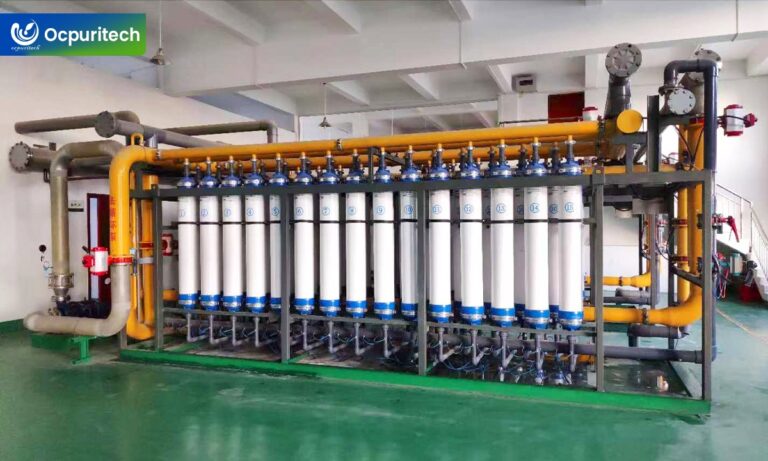
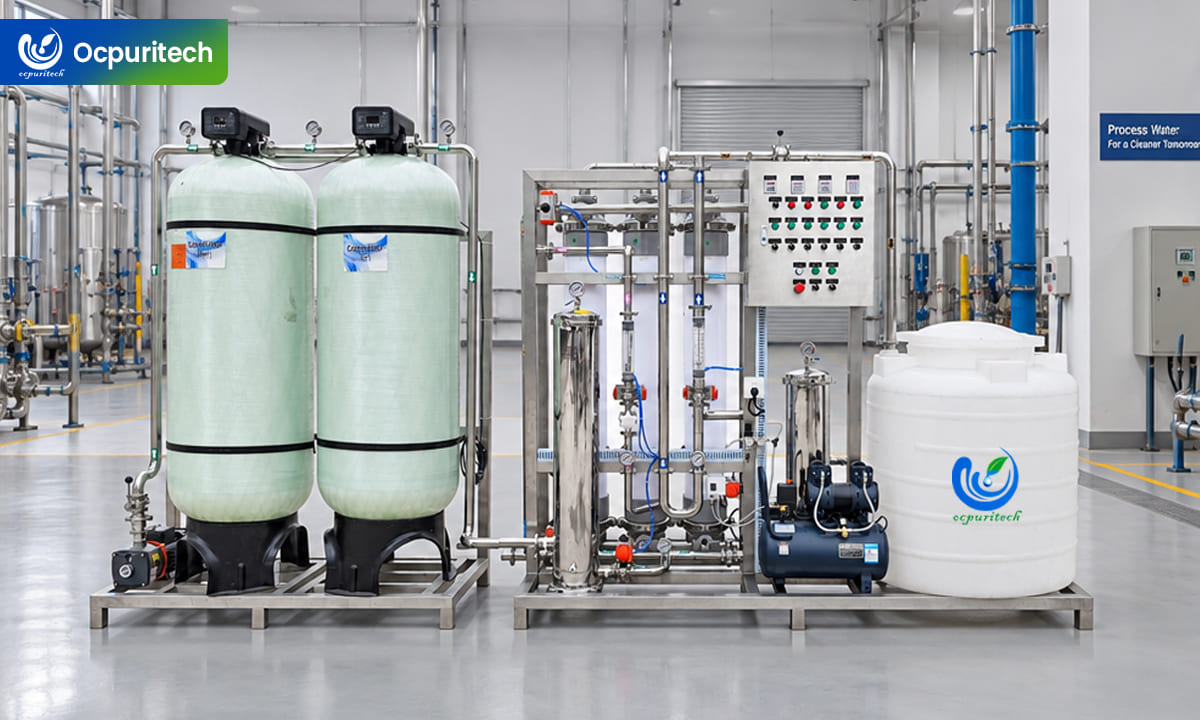
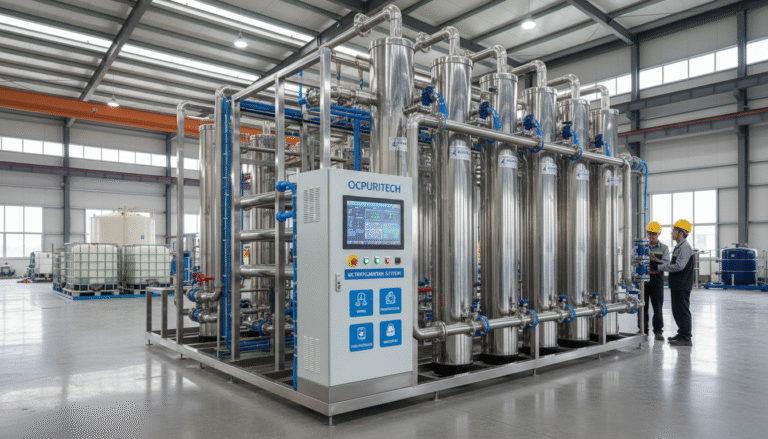
Conditions upstream of UF also matter. High solids or algae loading may require additional pretreatment, such as coagulation or clarification. Each stage should address an identified water-quality problem. For available capacities and equipment configurations, explore our industrial Ultrafiltration (UF) systems.
How Should a UF System Be Designed for Your Facility?
A UF system must fit the facility’s operating conditions, including seasonal changes, cleaning periods and the staff available to maintain it. Three questions help reveal whether the proposed design will work on site.
- What happens when feed-water conditions change? Confirm the expected temperature range and seasonal changes in turbidity, suspended solids and algae. The supplier should explain how these conditions affect membrane loading, filtration cycles and cleaning requirements.
- How will water demand be met during cleaning? Backwashing and maintenance interrupt filtration. Depending on the acceptable downtime, the design may need treated-water storage, parallel trains or standby equipment. Confirm how the proposed arrangement supports essential water demand.
- How will operators identify and respond to problems? Define the required flow, pressure and filtrate-quality monitoring, together with alarm responses and membrane integrity checks appropriate to the application.
I would also ask who will handle routine cleaning, chemical preparation and fault diagnosis. These tasks should match the site team’s capabilities, with clear operating instructions and an agreed support arrangement.
What Should You Check Before Buying a UF System?
A Ultrafiltration (UF) system quotation should distinguish filtration flow, net usable output and daily water delivery. These figures describe different aspects of capacity.
For example, a facility needing 200 m³ of usable water within a 20-hour operating window requires an average net supply of 10 m³/h. The supplier should explain how backwash water, cleaning downtime and storage affect the required filtration capacity. Confirm which losses are already included in the calculation to avoid counting them twice.
| Confirmation Item |
What I Expect the Quote to Specify |
| Design Basis |
Raw water analysis, design temperature, and target product water quality. |
| Membrane Configuration |
Membrane brand, model, total effective area, quantity, and design flux rate. |
| Available Water |
Net production rate, daily production volume, backwash water usage, and the conditions used for these calculations. |
| Cleaning & Maintenance |
Configuration for backwash, chemically enhanced backwash (CEB), and clean-in-place (CIP); triggers and chemical requirements. |
| Scope of Supply |
Which pumps, tanks, instruments, controls, pre-treatment, and spare parts are included. |
| Acceptance Criteria |
Conditions for testing water quality, flow rate, and run cycles; clarification of responsibilities. |
For cost, I list the equipment and installation costs separately from the operational costs like electricity, chemicals, and eventual membrane replacement. When comparing the cost per unit of water, always use the net usable water production as the basis. Only quotes based on the same conditions are truly comparable.
Ultrafiltration is a key technology in modern water treatment. When applied correctly, it provides an effective barrier against particles and helps protect your production processes, but it is not a universal solution. Share your feed water quality, industrial application, and any requirements for combining UF with technologies such as reverse osmosis. Our engineering team will develop a customized water treatment solution for your project, free of charge.