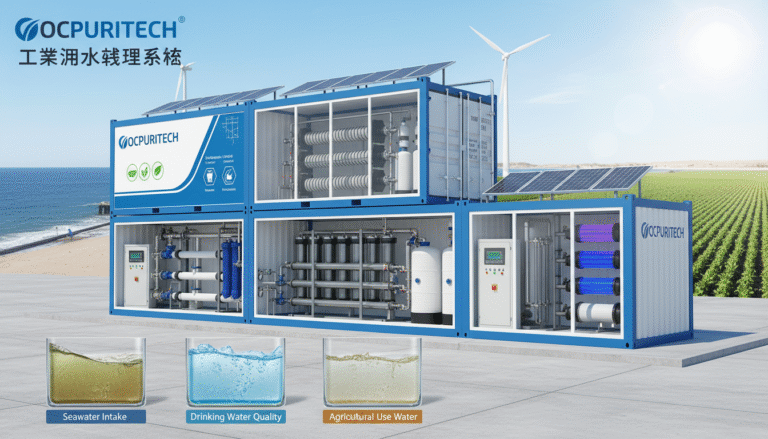
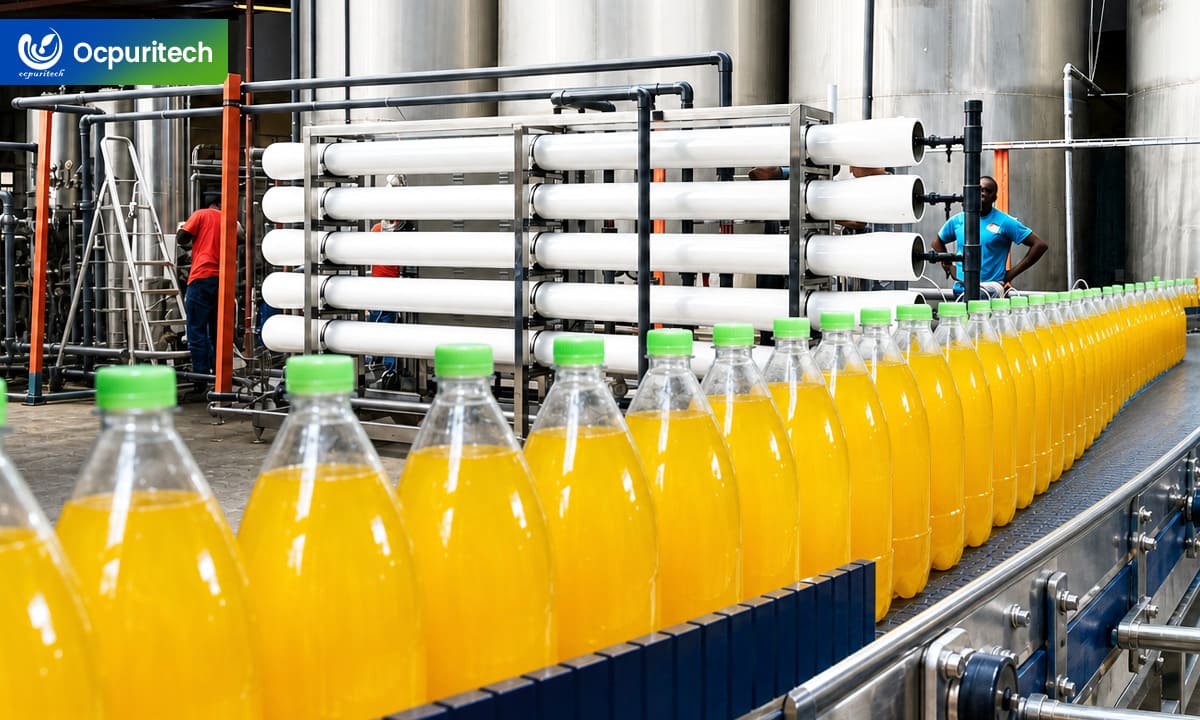
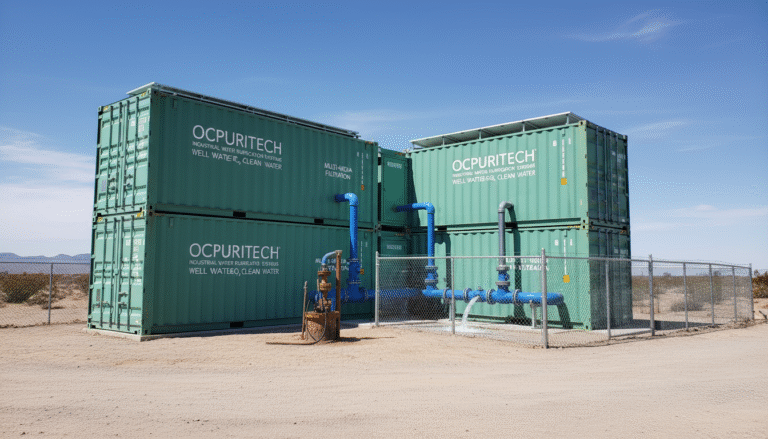
An RO water treatment system for juice production strips out the dissolved solids, hardness minerals, and microbial load that quietly wreck product flavor, color, and shelf life — often before anyone figures out the water is the problem.
Juice production requires RO-treated water with a TDS below 10 mg/L (10 ppm), a salt rejection rate of ≥97%, and a recovery rate between 65–75%. Feed water must first pass through multimedia filtration, activated carbon filtration, and a 5-micron cartridge filter before reaching the RO membranes. The sections below explain how to size the system, what pretreatment your specific feed water needs, and what the full cost looks like over five years.
1. Why Water Quality Determines Juice Quality
Water isn’t just an ingredient in juice production — it’s in everything. Dilution, rinsing, CIP, direct formulation. A fruit juice at 30% concentrate is still 70% water, and that 70% is where most quality problems quietly begin.
High TDS distorts flavor. Chlorine above 0.1 mg/L eats through fruit pigments and wipes out vitamin C. Hardness above 200 mg/L as CaCO₃ builds scale on heat exchangers within a few weeks of startup. Suspended solids above 1 NTU block filters downstream.
In my experience, the defect that gets traced back to water most often isn’t microbial — it’s inconsistent product color. Specifically, hardness ions reacting with anthocyanins in berry-based and fruit-concentrate drinks. The batch looks fine, then it doesn’t, and no one thinks to test the water.
Get RO upstream, and the water hitting your mixing tanks runs below 10 ppm TDS, no detectable chlorine, zero hardness. At that point, product consistency is your fruit supplier’s problem, not yours.
So — how does a reverse osmosis system actually remove all of that?
2. How RO Water Treatment System Works in a Juice Factory
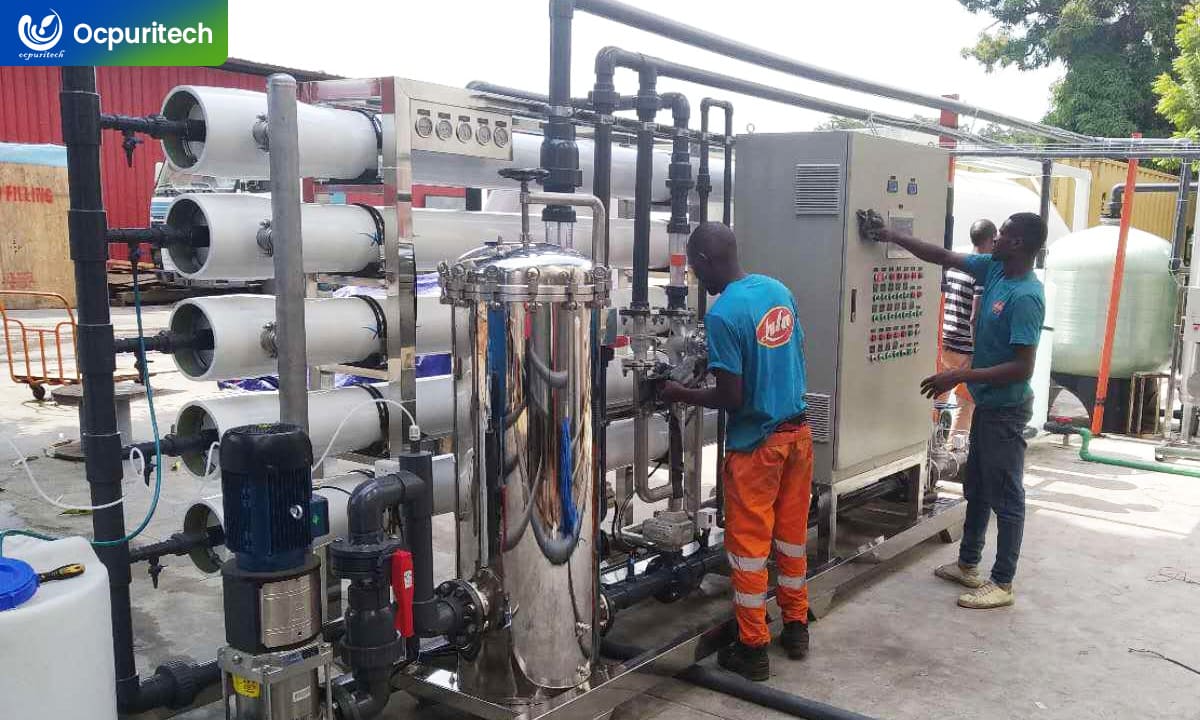
The core mechanism is simple: water is pushed under pressure through a semi-permeable membrane. The membrane has pores small enough to block dissolved salts, minerals, bacteria, and viruses — but water molecules pass through. What comes out the other side is permeate (clean water). What gets left behind exits as concentrate.
- High-pressure pump system — drives feed water through the membrane at 8–15 bar (116–218 psi) for brackish water sources
- Multimedia filter — removes suspended solids and turbidity before the membrane
- Activated carbon filter — strips chlorine and organic compounds that would damage the membrane material
- Antiscalant dosing system — prevents mineral scaling on the membrane surface
- 5-micron cartridge filter — final guard filter before the high-pressure pump
- RO membrane array — the core filtration stage; spiral-wound polyamide elements in 4040 or 8040 format
- Control and monitoring system — manages pressure, flow, TDS readings, and automatic CIP cycles
Each component has a job. Remove one, and something downstream pays the price — usually the membrane, usually expensively.
3. Benefits of Installing an RO System in a Juice Factory
Most juice manufacturers come to us for one of two reasons: a product quality problem they can’t trace, or a cost problem they can see clearly. RO systems tend to solve both.
1. Consistent product quality Water is the variable that most juice QC teams don’t measure until something goes wrong. RO eliminates that variable. When your ingredient water runs at a fixed TDS and zero chlorine, batch-to-batch color and flavor variation drops significantly.
2. Compliance with food safety standards Markets in the EU, US, and Middle East impose strict water quality requirements on food and beverage production. An RO system with NSF/ANSI 61-certified components gives you documented proof that your process water meets food-contact standards — useful for audits, certifications, and export market access.
3. Lower long-term production costs Buying bottled or tanker-delivered water for a production facility is expensive and logistically complicated. On-site RO production typically pays back its capital cost within 2–3 years and continues generating savings for the life of the system.
4. Reduced equipment wear Hard water causes scaling on heat exchangers, boilers, and filling valves. Softened, low-TDS permeate extends the service life of downstream equipment and reduces unplanned downtime for descaling.
5. Flexible capacity and customization RO systems are modular. A factory starting at 5,000 L/day can install a single-pass system and add a second train when production scales. Systems can also be configured for specific water sources — municipal supply, borehole, surface water — without changing the core membrane technology.
That said, the benefits above only materialise if the system is designed around your actual water. Which starts with knowing what’s in it.
4. What Feed Water Parameters Should an RO System Accept?
Before you pick a RO unit, get your water tested. Not a general “it looks fine” — an actual lab report with numbers. Skip this step and you’ll either overbuy or end up with a membrane that fouls in year one. The eight parameters below drive every design decision:
| Parameter |
Acceptable Feed Water Range |
Impact If Exceeded |
| TDS |
200–1,500 mg/L (standard BWRO) |
Higher TDS → lower recovery rate, higher energy |
| Total Hardness |
≤500 mg/L as CaCO₃ |
Calcium/magnesium scaling on membranes |
| Free Chlorine |
≤0.1 mg/L |
Membrane oxidation — irreversible damage |
| Iron (Fe) |
≤0.1 mg/L |
Iron fouling — brown discoloration on membranes |
| Turbidity |
≤1 NTU after pretreatment |
SDI spike, membrane blocking |
| pH |
6.5–7.5 at membrane inlet |
Outside range = accelerated membrane degradation |
| Temperature |
15–35°C (59–95°F) |
Permeate flux drops ~3% per °C below 25°C |
| SDI₁₅ |
≤5 (ideally ≤3) |
Colloidal fouling, rapid pressure rise |
If your source is municipal tap water, TDS typically falls between 150–500 mg/L — well within standard BWRO range. If you’re drawing from a borehole or a surface source, iron, manganese, and biological load become the critical pretreatment variables.
Once you have those numbers, the next question is what needs to happen to the water before it reaches the membrane.
5. The Pretreatment Train: What Comes Before the RO Membrane
Poor pretreatment is the most reliable way to shorten membrane life from 3 years to under 12 months. The sequence below is standard for juice production facilities:
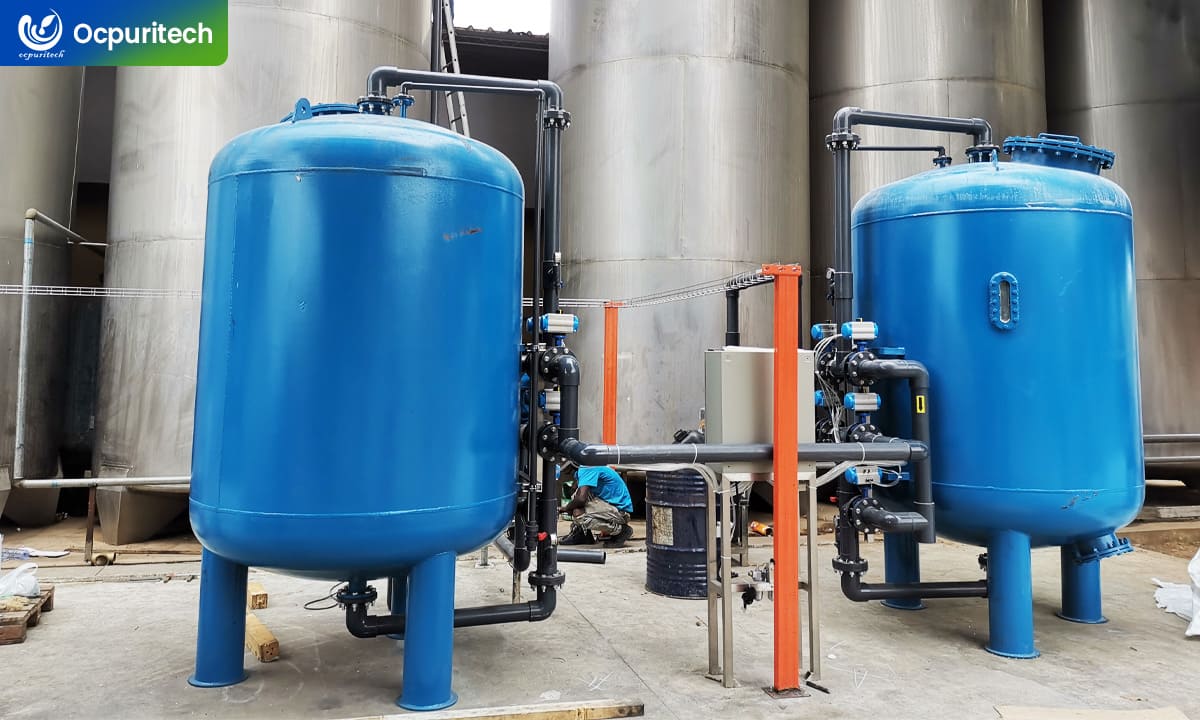
1. Multimedia Filter (MMF) Removes suspended solids and reduces turbidity to below 1 NTU. Backwash cycle: every 24–48 hours, depending on source turbidity.
2. Activated Carbon Filter (ACF) Removes free chlorine, chloramines, and organic compounds that oxidize polyamide membranes. Carbon media should be replaced every 12–18 months, or when effluent chlorine exceeds 0.02 mg/L.
3. Water Softener (if hardness > 200 mg/L as CaCO₃) Ion exchange resin swaps calcium and magnesium for sodium, blocking CaCO₃ and CaSO₄ scaling on membranes. Some facilities use antiscalant dosing instead — lower CAPEX but higher chemical cost at high flow rates.
4. Antiscalant Dosing System Injected into the feed line before the high-pressure pump. Inhibits precipitation of sparingly soluble salts at the membrane surface. Dosing rate is typically 2–5 mg/L, calculated based on the Langelier Saturation Index (LSI) of your feed water.
5. 5-Micron Cartridge Filter Final polishing step before the high-pressure pump and membrane array. Acts as a guard filter to catch any media that escapes upstream vessels. Replace every 3–6 months or when differential pressure exceeds 1 bar (14.5 psi).
Now that the water is clean enough to enter the membrane, you need to know what the membrane itself should be delivering.
6. Key Technical Parameters for an RO Water Treatment System for Juice Production
A supplier’s technical datasheet may contain dozens of figures, but in my experience, seven key specifications are particularly important when evaluating an RO water treatment system for juice production.
| Parameter |
Typical Range |
Notes |
| Salt Rejection Rate |
≥97% (standard), ≥99% (high-rejection membranes) |
Measured at 25°C (77°F), 250 mg/L NaCl, 15% recovery |
| Recovery Rate |
65–75% |
Juice factories typically use 70%; higher recovery increases concentration polarization |
| Permeate TDS |
<10 mg/L |
Starting from feed TDS of 300–500 mg/L |
| Operating Pressure |
8–15 bar (116–218 psi) for BWRO |
Pressure increases as membranes age |
| Energy Consumption |
0.3–0.8 kWh/m³ of permeate |
BWRO range; excludes pretreatment pumps |
| Design Temperature |
25°C (77°F) nominal |
Flux drops ~3% per °C; correct sizing for your local water temperature |
| Membrane Type |
4040 or 8040 spiral-wound polyamide |
8040 elements for capacities above 5 m³/h |
All parameters subject to actual feed water conditions. Always request a system design proposal with ROSA or IMSDesign output from your supplier.
7. How to Size an RO System for Your Juice Factory
The question isn’t really “what size system do I need” — it’s “how much clean water does this factory actually burn through in a day.” Most buyers underestimate this because they only count the juice. They forget the CIP cycles, the equipment rinses, the boiler.
The most common sizing mistake: specifying the RO system on nominal production output, not actual water demand across all uses.
Step 1: Calculate total water demand
Add up all water consumers in your facility:
- Direct ingredient water (dilution, blending)
- CIP water (typically 1.5–3× system volume per cycle, 1–2 cycles per day)
- Boiler feed water (if steam is used for pasteurization)
- Rinsing and cooling
Step 2: Apply the recovery rate correction
Your RO system produces permeate at its recovery rate. To get 1,000 LPH (264 GPH) of purified water at 70% recovery:
Feed water flow = Permeate flow ÷ Recovery rate 1,000 LPH ÷ 0.70 = 1,429 LPH feed water required
The remaining 429 LPH exits as concentrate (brine).
Step 3: Apply a safety factor
For continuous operations, apply a 1.2× safety factor on top of peak demand. A facility requiring 2,000 LPH permeate during peak should specify a system rated for 2,400 LPH (634 GPH).
| Juice Plant Daily Output |
Estimated Water Demand |
Recommended RO Capacity |
| 500 L/day (small batch) |
~1,500 L/day |
500 LPH (132 GPH) — 3 hrs/day |
| 5,000 L/day |
~12,000 L/day |
2,000 LPH (528 GPH) |
| 20,000 L/day |
~50,000 L/day |
8,000 LPH (2,113 GPH) |
| 100,000 L/day |
~250,000 L/day |
40,000 LPH (10,567 GPH) — multi-train |
Before committing to RO, though, some buyers wonder whether ultrafiltration might be enough. Here’s how the two compare.
8. RO vs. UF for Juice Production Water Treatment
Procurement managers ask me this regularly: “Can we just use an ultrafiltration system instead of RO? It’s cheaper upfront.”
It depends on what your process actually requires:
| Criterion |
RO System |
UF System |
| TDS removal |
95–99% |
<5% (UF does not remove dissolved solids) |
| Hardness removal |
≥97% |
Near zero |
| Bacteria/virus rejection |
≥99.9% |
99%+ bacteria; viruses: membrane-dependent |
| Permeate TDS target |
<10 mg/L |
Same as feed (UF does not reduce TDS) |
| Primary use case |
Ingredient water, boiler feed |
Pre-RO pretreatment, CIP water polishing |
| Energy (kWh/m³) |
0.3–0.8 |
0.05–0.2 |
| Best suited for |
Juice blending, soft drink production |
High-turbidity sources as RO pretreatment |
If your source water runs above 100 mg/L TDS or 100 mg/L hardness as CaCO₃, you need RO for ingredient water. UF doesn’t reduce dissolved solids — it’s a pretreatment step, not a substitute.
One thing both systems share, however, is a byproduct stream. And that’s worth planning for before you finalise the design.
9. Concentrate (Brine) Disposal: The Part Nobody Talks About
When your RO system produces clean water, it also produces a smaller stream of water with everything it removed — salts, minerals, and dissolved solids concentrated into a reject stream. What you do with that water matters, and most suppliers won’t bring it up unless you ask.
At a 70% recovery rate, 30% of your feed water exits as concentrate with roughly 3× the TDS of the incoming water. At a capacity of 10 m³/h, that’s 3 m³/h of concentrate.
- Drain to wastewater treatment: the most common approach in juice factories already operating a wastewater system. Check local discharge TDS limits — many municipalities cap at 1,500–2,000 mg/L.
- Recycle for CIP or equipment rinsing: concentrate is still clean water by most standards; it simply has elevated dissolved solids. For low-sensitivity rinsing steps, this reduces overall water consumption.
- Partial recirculation to feed: increases effective recovery to 80–85%, but requires careful LSI monitoring to avoid scaling the membrane on the recirculated stream.
Concentrate disposal left unplanned at the design stage is a recurring reason juice manufacturers face local discharge violations six months after commissioning.
Beyond disposal, the other number every buyer eventually asks about is cost. Here’s what the full picture actually looks like.
10. Total Cost of Ownership: What Five Years Actually Costs
Capital cost represents only 40–50% of the five-year total. Here’s a realistic breakdown for a mid-size 3,000 LPH (792 GPH) system:
| **Cost Category |
Year 1 |
Years 2–5 (annual) |
5-Year Total |
| Equipment (CAPEX) |
18,000–18,000–28,000 |
— |
18,000–18,000–28,000 |
| Installation & commissioning |
3,000–3,000–5,000 |
— |
3,000–3,000–5,000 |
| RO membranes (replace yr 3–5) |
— |
2,000–2,000–4,000 |
4,000–4,000–8,000 |
| Cartridge filters (6×/year) |
$600 |
$600 |
$3,000 |
| Antiscalant / chemicals |
$800 |
$800 |
$4,000 |
| Energy (0.5 kWh/m³, 16 hrs/day) |
1,200–1,200–2,000 |
1,200–1,200–2,000 |
6,000–6,000–10,000 |
| Labor / maintenance |
$1,500 |
$1,500 |
$7,500 |
| 5-Year TCO (estimate) |
|
|
45,500–45,500–65,500 |
Estimates based on typical BWRO systems for food-grade applications. Actual costs vary with feed water quality, local energy rates, and membrane brand. Request a detailed TCO proposal from your supplier.
The most expensive mistake is buying on unit price and neglecting pretreatment. An underdimensioned activated carbon filter will destroy membranes within 12–18 months, turning a 2,000″saving”intoa2,000″saving”intoa6,000 membrane replacement.
A properly specified RO water treatment system for juice production typically recovers its capital cost within 2–3 years, mainly through reduced bottled water purchasing and fewer membrane failures.
11. What Certifications Should a Juice Industry RO System Carry?
A juice factory buying an RO water treatment system for juice production is ultimately making a food safety decision. The certifications below tell you whether the system was built to food-contact standards — and whether your auditor will accept it.
When purchasing for a food or beverage facility, check that the system and its components carry:
- ISO 9001: Quality management system for the manufacturer
- CE Marking: Compliance with EU machinery and pressure equipment directives (required for EU market)
- NSF/ANSI 61: Certifies that water-contact components (membranes, housings, tubing) do not leach contaminants into drinking water — critical for food-grade applications
- FDA 21 CFR: If producing for the US market, wetted components must comply
- GMP compliance documentation: Required for pharmaceutical-grade juice operations (e.g., nutraceutical or fortified beverages)
Request component-level certificates from your supplier — a system-level claim with no supporting documentation is not auditable.
Once the system is installed and certified, what keeps it running well comes down to maintenance discipline.
12. Maintenance Schedule: Keeping Your RO System Running
An reverse osmosis water treatment system isn’t a “set it and forget it” piece of equipment. Think of it like a car: the engine runs well when you service it on schedule, and fails expensively when you don’t. The difference is that a membrane replacement costs more than an oil change.
A juice factory RO system running 16 hours/day, 300 days/year produces ~14.4 million liters of purified water annually. Six maintenance tasks keep it there:
| Task |
Frequency |
Trigger Condition |
| Cartridge filter replacement |
Every 3–6 months |
Differential pressure >1 bar (14.5 psi) |
| Activated carbon media check |
Monthly chlorine test |
Effluent chlorine >0.02 mg/L |
| CIP membrane cleaning |
Every 30–90 days |
Normalized permeate flux drop >15% |
| Antiscalant dosing check |
Weekly |
LSI calculation from feed water analysis |
| Membrane replacement |
Every 3–5 years |
Salt rejection <95% after CIP |
| Full system inspection |
Annually |
Scheduled preventive maintenance |
Track normalized permeate flux and normalized salt rejection, not raw readings. Raw values shift with temperature and pressure; normalized figures show actual membrane condition.
FAQ
What TDS should RO product water reach for juice production?
For direct ingredient water (blending, dilution), target TDS below 10 mg/L. For general process water (rinsing, CIP), below 50 mg/L is acceptable. Always verify against your specific product quality standard and any applicable food safety certifications.
How long do RO membranes last in a juice factory?
With proper pretreatment — particularly chlorine removal via activated carbon and controlled scaling through antiscalant or softener — spiral-wound polyamide membranes last 3–5 years. Chlorine exposure above 0.1 mg/L is the single most common cause of premature membrane failure.
Can one RO system serve both ingredient water and CIP water demands?
Yes, but the system must be sized to cover simultaneous demand peaks. More commonly, a dedicated permeate storage tank (sized for 4–8 hours of production) buffers the two demand streams, allowing the RO to run continuously at optimal flux rather than cycling with variable demand.
What happens if my feed water TDS is above 2,000 mg/L?
Standard BWRO membranes are rated for feed water up to 2,000 mg/L TDS. Above that threshold, you need high-rejection membranes, a two-pass RO configuration, or a review of your source. Feed water above 5,000 mg/L typically requires SWRO (seawater RO) elements with operating pressures in the 40–70 bar (580–1,015 psi) range.
Do we need UV sterilization on top of RO?
RO membranes reject bacteria at ≥99.9%, but they are not sterilizing filters. For food-grade ingredient water, a post-RO UV sterilizer (254 nm, minimum 30 mJ/cm²) is strongly recommended as a final biosecurity layer — particularly if product water is stored in tanks before use.
Conclusion
An RO water treatment system doesn’t eliminate all water-related problems, but it eliminates the unpredictable ones. Feed water composition varies by season, source, and geography. RO output doesn’t. Once you’ve dialed in the pretreatment and sized the system correctly, what arrives at your mixing tanks is consistent every day.
The decisions that matter most happen before purchase: water quality analysis, pretreatment design, capacity calculation, and concentrate disposal planning. Get those right, and the system itself is relatively straightforward to operate and maintain.
At Ocpuritech, we’ve designed and commissioned RO water treatment systems for juice and beverage manufacturers across 80+ countries. Our standard juice-grade systems are built with food-contact-compliant 304/316L stainless steel wetted parts, automatic CIP function, and remote monitoring capability. If you need an RO water treatment system for juice production sized for your specific feed water and production volume, contact our engineering team for a technical proposal.