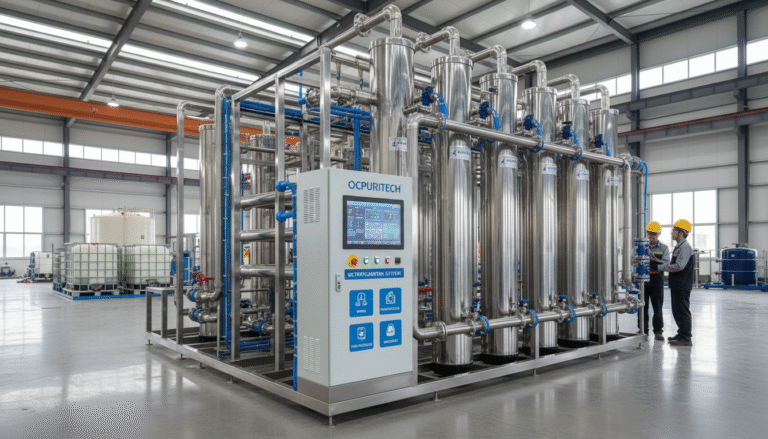
Ultrafiltration (UF) membranes with a 0.01–0.1 µm pore size remove bacteria, colloids, suspended solids and turbidity from farm water. They do not remove dissolved salts, nitrate or dissolved iron. So an ultrafiltration system for poultry and swine farms solves microbial and turbidity problems, not salinity problems. If your well water is high in TDS, UF alone will not fix it. This guide explains how to choose the right livestock water treatment system for poultry and swine farms, how to size it, what it costs, and how to keep it running.
Most failed farm systems I inspect did not fail because of the membrane. They failed because nobody checked the feed water first.
Poultry and Swine Farm Water Quality Requirements for UF Systems
Every livestock water treatment decision starts with a raw water analysis. Most guides cover only one species. Here are both poultry and swine.
| Parameter |
Poultry guidance |
Swine guidance |
Why it matters |
| TDS |
Below 1,000 ppm: no burden. 3,000–4,999 ppm: poor quality water (NRC 1974, via Intec America) |
Below 1,000 ppm: generally no risk. Above 7,000 ppm: risk to gestating sows (Pork Gateway) |
High TDS suppresses water intake, then feed intake |
| Bacteria / coliform |
Should be absent |
Should be absent |
Disease pressure and biofilm fuel |
| Turbidity |
Low turbidity needed for disinfection to work |
Same |
Solids shield bacteria from chlorine |
| Hardness |
Scales lines, heaters, medicators |
Same |
Cuts equipment life |
One important point: always confirm the limits in your own country, because local regulations take priority over general guidance. TDS is also a summary number, not a contaminant. Two wells at 1,200 ppm can behave very differently depending on what makes up that figure.
Before you request a quotation, get a recent water analysis. If you do not have one, I would not recommend selecting the equipment yet. The pretreatment section below lists what to test.
What Water Sources Can an Ultrafiltration System for Poultry and Swine Farms Treat?
Before selecting a livestock water treatment system, I always look at the farm’s water source first. Poultry and swine operations may rely on well water, borehole water, surface water, river water, or municipal supplies, and each source creates a different treatment challenge.
| Water Source |
Common Water Quality Issues |
UF Suitability |
| Well or borehole water |
Iron, manganese, hardness, dissolved salts |
Depends on the water analysis |
| River or surface water |
High turbidity, suspended solids, bacteria and organic matter |
Good with appropriate pretreatment |
| Pond or stored surface water |
Turbidity, algae, bacteria and organic contamination |
UF may be suitable after pretreatment |
| Municipal water |
Generally lower turbidity, but microbial or residual chlorine issues may still require attention |
Often filtration or disinfection is sufficient; UF depends on the application |
The key point is that UF is not selected simply because the water comes from a farm well or surface source. The treatment train should be based on what is actually in the water. For example, UF can be highly effective when the main problems are turbidity, suspended solids and microbial contamination, but it cannot remove dissolved salts or reduce TDS significantly.
That is why I recommend testing the source water before choosing between UF, RO, or a combined UF + RO system.
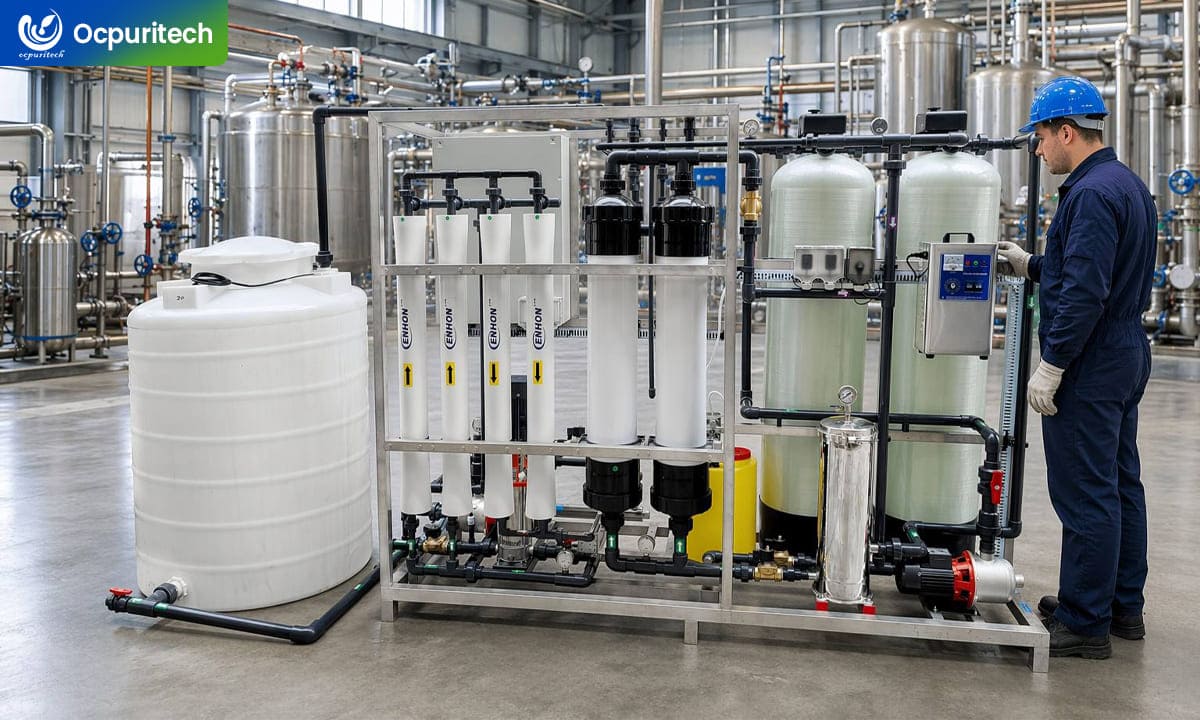
Why Chlorination Alone Fails: The Biofilm and Turbidity Problem
Most farms already dose chlorine. Many still have dirty water lines. The reason is physical, not chemical. Chlorine kills what it can reach, but it does not remove anything. On a farm, several physical problems can limit what chlorine achieves:
- Turbidity shields bacteria. Suspended particles block contact with chlorine. Disinfection efficiency drops as turbidity rises.
- Biofilm resists it. Once biofilm establishes inside a line, the outer layer sacrifices itself and the colony underneath survives. Routine dosing does not penetrate it.
- Dead cells stay in the water. Chlorine kills bacteria but leaves cell debris in suspension — the organic load that feeds the next biofilm.
Ultrafiltration is a physical barrier. Anything larger than the pore rating stays behind and leaves during backwash.
That is the honest distinction: chlorination inactivates, ultrafiltration removes. On farms with recurring line fouling, removal is what breaks the cycle. Many operations run both — UF as the barrier, a small residual for line protection downstream. A UV sterilizer is another option where a chemical residual is not wanted.
If your lines foul again within weeks of flushing, the problem is probably upstream of your dosing. Before increasing your chlorine spend, test the turbidity of the incoming water.
Ultrafiltration vs Reverse Osmosis: Which One Does Your Farm Need?
This is where I will lose some enquiries. Better here than after you have paid.
UF does not desalinate. It will not lower TDS meaningfully, and it will not remove nitrate, sulphate or fluoride. If your problem is salinity, UF will disappoint you no matter who builds it.
Use this decision path to determine which water treatment technology is appropriate for your livestock operation.
| Your feed water condition |
What you need |
Reason |
| TDS below ~1,000 ppm, but bacteria, turbidity or biofilm problems |
UF |
Microbial and particulate problem only |
| TDS above ~1,000 ppm, or nitrate/sulphate above local limits |
RO (brackish water RO) |
Dissolved salts need a desalination membrane |
| High TDS and high turbidity or organics |
UF + RO |
UF protects the RO membranes |
| Municipal supply, only occasional line fouling |
Filtration plus disinfection review |
A full membrane plant may be over-specified |
These thresholds are guidance, not a rule. The correct decision depends on your full analysis, species and production stage.
The third row is worth understanding. Where both problems exist, UF is not competing with RO — it is protecting it. Feeding turbid water straight to RO membranes shortens their life and drives up cleaning frequency.
Start with the TDS figure. It is the first indication of whether you should be looking at UF, RO, or a combination of both.
How to Size a UF System for Your Farm
Sizing is arithmetic. You can do it yourself in ten minutes.
Step 1 — Calculate daily water demand.
Daily demand (L/day) = animal count × daily water use per animal (L)
                       × peak factor
Use your own metered consumption. If you do not have it, take the figure from your breed or genetics management guide — consumption varies by species, age, feed and climate. Do not use a generic internet number for a capital purchase.
Apply a peak factor of at least 1.2–1.5. Hot weather, medication events and cleaning cycles all spike demand above average. Add washdown or processing demand separately.
Step 2 — Convert demand into system flow.
Required capacity (LPH) = daily demand (L/day) ÷ effective operating hours
Effective hours are not 24. Reserve time for backwash and maintenance, and design on 20–22 hours. A larger storage tank lets you run a smaller, cheaper skid for longer each day.
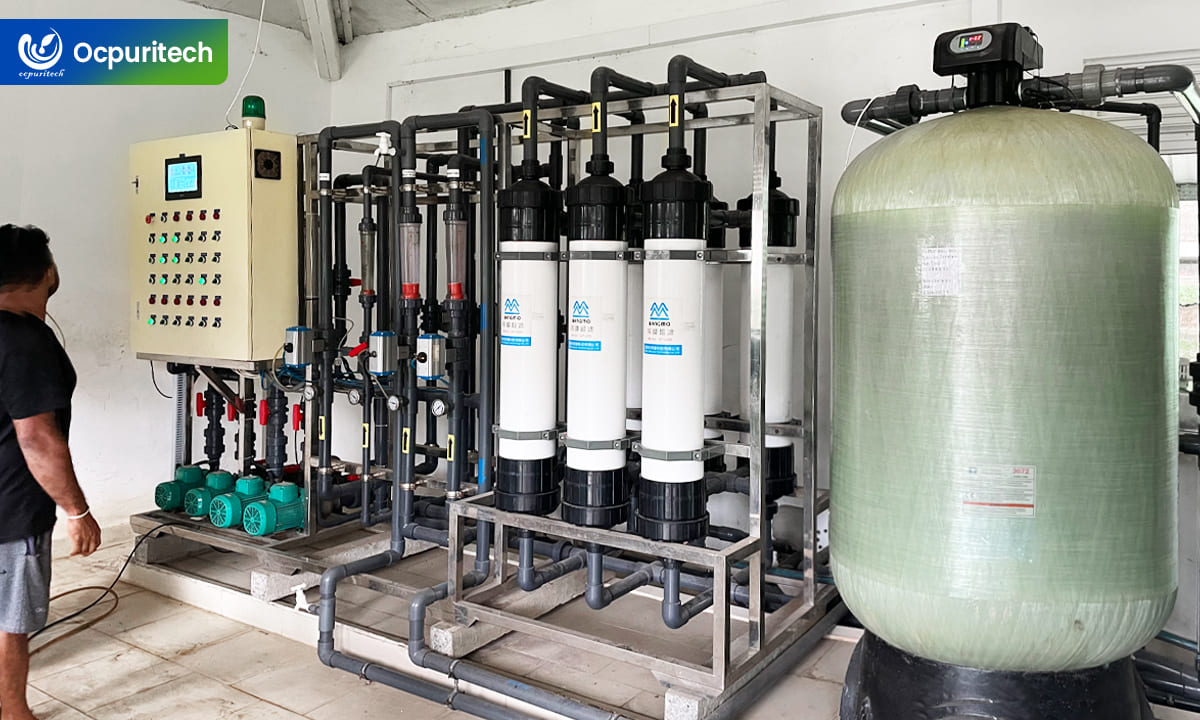
Worked example. A farm calculates 120,000 L/day. On 20 effective hours that gives 6,000 LPH, or 6 m³/h (1,585 GPH) — the size of the Sri Lanka system below.
Step 3 — Check membrane loading.
Capacity alone does not define the system. The same 6 m³/h can be built with different membrane areas, and the cheap version fails early. Ask for the design flux in LMH (litres per square metre per hour). Lower flux means more membrane area for the same output — more upfront cost, much slower fouling.
Design flux must be quoted against stated conditions: feed turbidity, water temperature and target recovery. A flux figure with no conditions tells you nothing. Colder water is more viscous and cuts output at the same pressure, so cool climates need derating. Recovery works the same way — ask for it to be guaranteed at your water quality, not in general.
Know your number? Send us your animal count and a recent water analysis. Our engineers will return a free sizing review with the pretreatment train for your feed water.
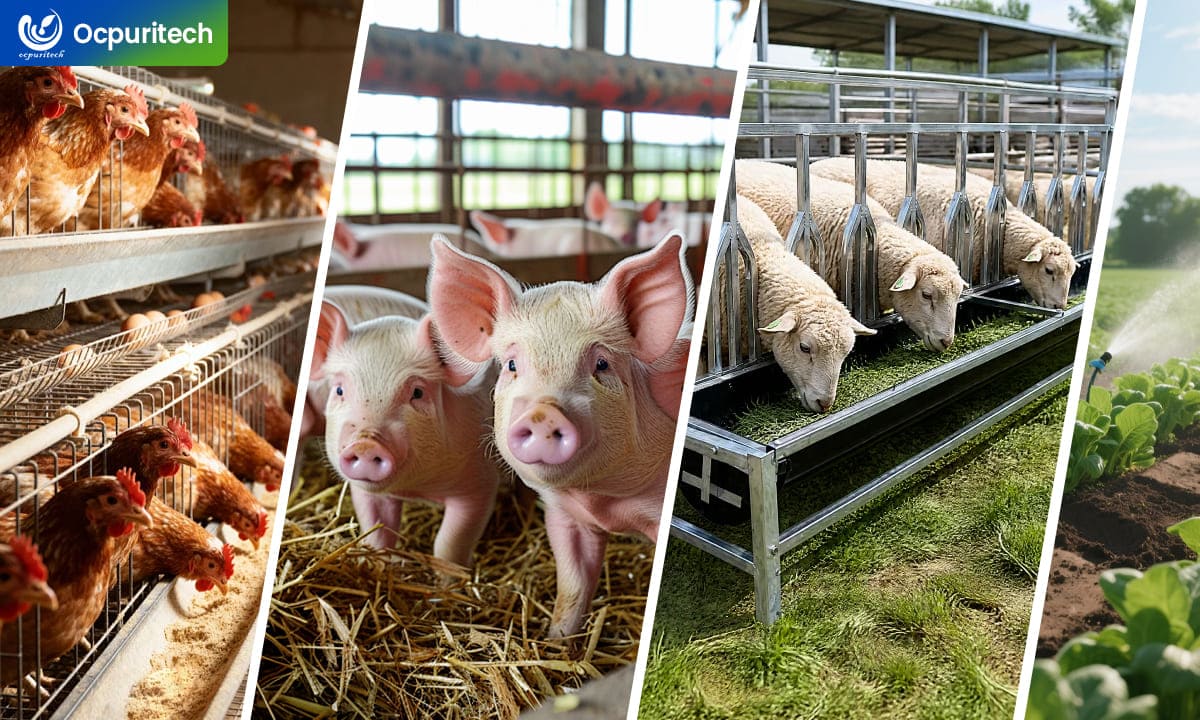
Pretreatment: The Step That Kills Most Farm UF Systems
If you read only one section, read this one. Most farm UF systems that fail early do not fail in the membrane. They fail because pretreatment was wrong or absent. A UF membrane is not self-defending — send it the wrong water and it will foul, scale or oxidise long before its design life.
Test these before anyone quotes you a system:
| Test |
Why it changes the design |
| Turbidity (NTU) |
Sets backwash frequency and design flux |
| SDI (Silt Density Index) |
Predicts fouling rate; essential if RO follows |
| Iron and manganese |
Oxidises and cements onto fibres; remove upstream |
| Hardness |
Scaling risk downstream |
| Residual chlorine / oxidants |
Attacks membrane polymer; carbon usually required |
| Total coliform and bacteria |
Confirms the real microbial load |
| TDS |
Decides UF vs RO |
| pH and temperature |
Affects flux, chemistry, material selection |
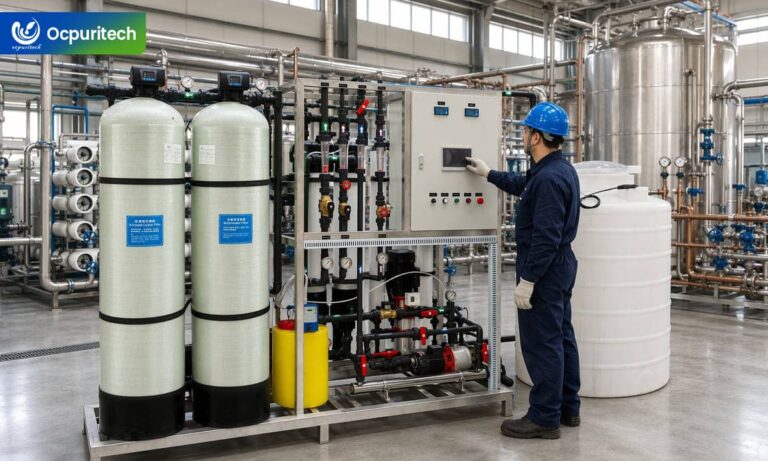
A typical farm pretreatment train is a multimedia sand filter, then activated carbon for oxidants and organics, with iron and manganese removal or antiscalant dosing where the analysis calls for it. Filter cartridges guard the membrane. Skipping this stage looks like a saving on the quotation. It is not — it moves the cost to your membrane budget.
I recommend getting these eight parameters tested by an accredited laboratory and sending the report to the supplier before accepting a quotation.
What Does a Farm UF System Really Cost?
I would not give you a fixed price without first seeing the required capacity and feed-water analysis. A UF system cannot be priced responsibly without knowing how it needs to be designed. What I can give you is the cost structure, so you can read a quotation and compare suppliers.
| Cost block |
What sits inside it |
What drives it up |
| CAPEX — membranes |
UF modules, housings |
Lower design flux = more area, higher cost, longer life |
| CAPEX — pretreatment |
Sand and carbon filters, dosing, iron removal |
Poor feed water quality |
| CAPEX — pumps and controls |
Feed pumps, PLC, valves, instruments |
Redundancy, automation level |
| CAPEX — skid and tanks |
Frame, piping, storage |
Material grade, capacity, layout |
| OPEX — energy |
Pumping (kWh/m³) |
Operating pressure, which rises with fouling |
| OPEX — membrane replacement |
Periodic module renewal |
Feed quality, pretreatment discipline |
| OPEX — chemicals |
Backwash and CIP chemicals |
Fouling rate |
| OPEX — labour |
Monitoring, cleaning |
Automation level |
There are two things I would look at before comparing quotations.
The cheapest quotation usually has the highest design flux — less membrane area for the same rated output. It performs on day one and fouls faster ever after. Compare membrane area and design flux, not just rated capacity and price.
Pretreatment is not an upsell line. Cutting it moves that money into your membrane replacement budget, usually with interest.
Building a budget? Send us your required capacity and water analysis for a budgetary quotation with the cost blocks itemised.
Case Study: A 6 m³/h UF System in Operation in Sri Lanka
A Sri Lankan customer needed treated water for a livestock operation running both poultry and swine. The same operation supplies raw material into the local food-service chain — burgers and fried chicken. The water had to be right for the animals and defensible in a food chain.
The project was designed around the site’s actual treatment requirements rather than a standard UF configuration. The system combines pretreatment, chemical dosing, ultrafiltration and automated control to provide a stable water supply for the farm.
| Parameter |
Specification |
| Permeate capacity |
6,000 LPH — 6 m³/h (1,585 GPH) |
| Output at 24 h operation |
144 m³/day (38,040 GPD) |
| UF membrane |
6 x 8040 UF membranes (PVC hollow fiber UF) |
| Pretreatment |
Multimedia sand filter + activated carbon |
| Chemical treatment |
Flocculant dosing system + chlorination system |
| Control system |
Corrosion-resistant painted panel with PLC + touchscreen |
| CIP / backwash |
1 duty + 1 standby CIP pump + backwash pump |
| Application |
Poultry and swine drinking water for continuous farm operations |
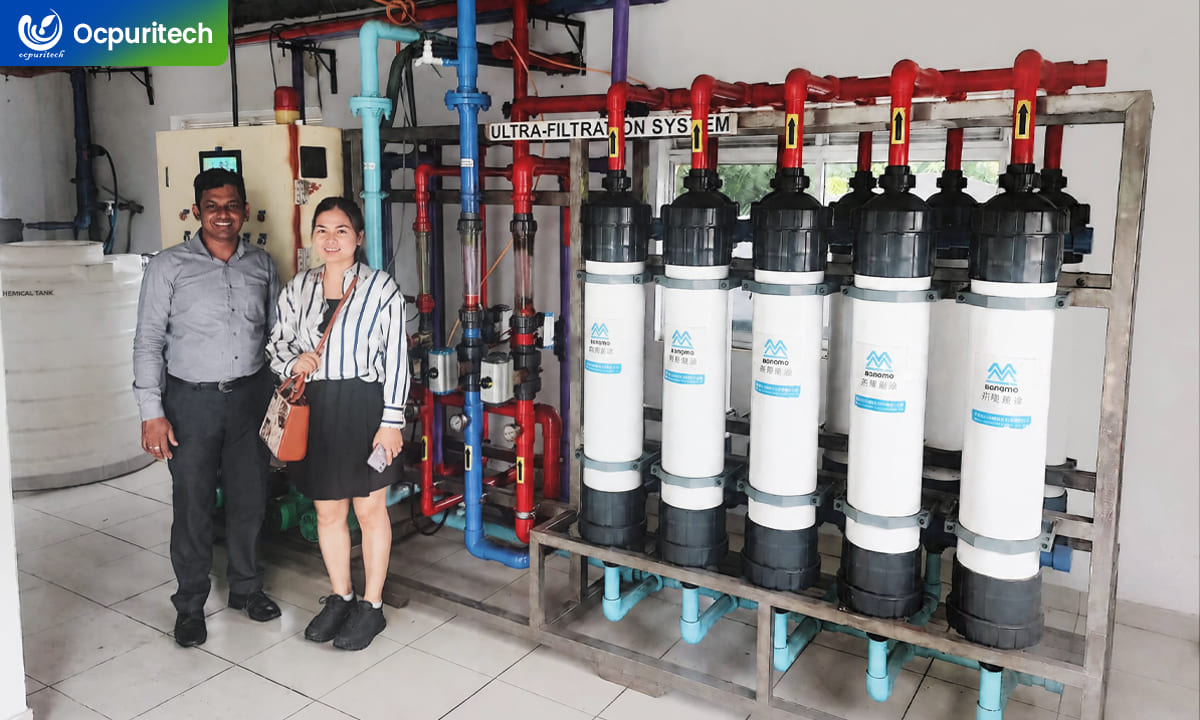
Three design choices are particularly important here.
The duty/standby pump arrangement. I argue for this on every farm project. A standby pump allows the system to switch over when the duty pump fails, reducing the risk of an extended water interruption.
Sand and carbon ahead of the membrane. This pretreatment helps reduce the fouling load before water reaches the UF membranes. The flocculant dosing system provides additional treatment where suspended and colloidal matter requires it.
PLC and touchscreen control. Farm staff are not water treatment operators. Automated control makes backwash and other operating sequences easier to manage, while the corrosion-resistant control panel is suited to the farm environment.
What the customer reports: the system has been in service for more than ten years, with normal operation across that period, supplying water around the clock.
Let me be precise about what that shows: this configuration was correctly matched to that site’s feed water. It does not mean a PVC UF membrane lasts ten years everywhere. High iron, high turbidity or residual oxidants can shorten membrane life. The long service life came from the match between the water, pretreatment and system design.
Daily Operation: Backwash, CIP and Membrane Life
A UF system is not maintenance-free. It is low-maintenance when automated and monitored properly.
| Task |
Typical interval |
Purpose |
| Automatic backwash |
Every 20–60 minutes of operation |
Removes the solids layer from the fibres |
| Record TMP, flow, turbidity |
Daily |
Your early warning system |
| Chemically enhanced backwash |
Weekly to monthly |
Removes what plain backwash cannot |
| Full CIP |
When TMP rises above your baseline |
Restores flux |
| Pretreatment media check |
Per supplier schedule |
Protects the membrane |
Intervals depend on your feed water. Your supplier should set these against your analysis, not hand you a generic table.
When the system starts behaving differently, I usually look at three things first:
- Output falling, TMP rising → fouling. Run a chemically enhanced backwash. If it does not recover, schedule a CIP.
- TMP normal, output still falling → check feed pump performance and water temperature. Cold water reduces flux at constant pressure.
- Permeate turbidity rising → possible fibre breakage. Stop and investigate before it reaches the animals. This is not a cleaning issue.
Log TMP from day one. Without a clean-water baseline you cannot tell fouling from normal variation, and most farms learn this the hard way.