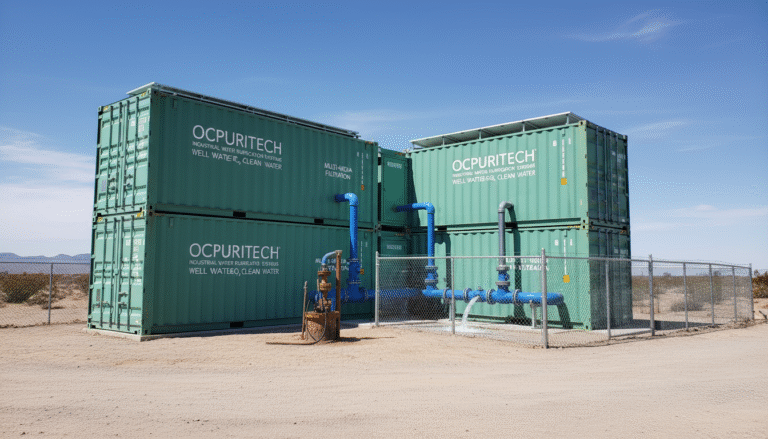
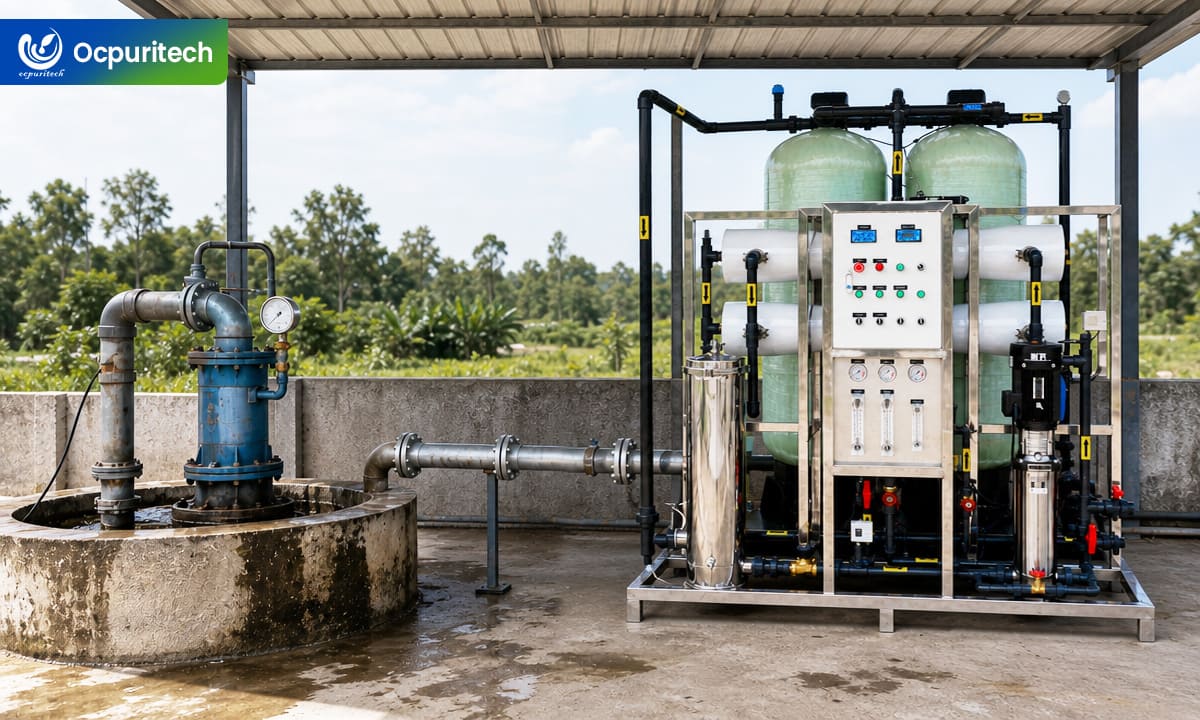
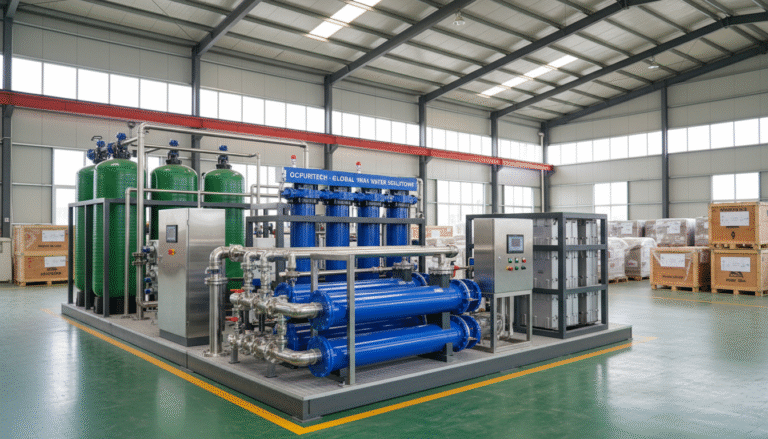
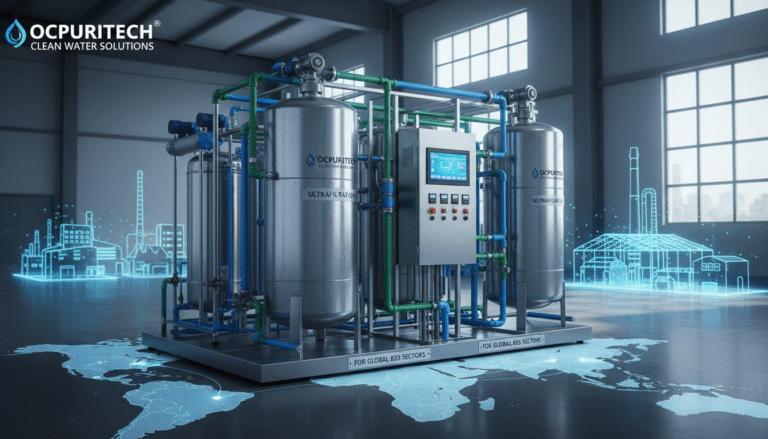
Well water treatment systems are designed to remove or reduce contaminants such as suspended solids, iron, manganese, hardness, dissolved salts, and microorganisms from groundwater. Depending on the raw water quality and intended application, these systems may use filtration, oxidation, softening, ultrafiltration (UF), reverse osmosis (RO), and disinfection.
For commercial and industrial projects, choosing the right system involves more than selecting a filter or RO unit. Buyers need to understand the well water composition, required finished water quality, sustainable well yield, and operating conditions.
I wouldn’t recommend RO simply because a project uses well water. A high-iron well may need oxidation and filtration, while a factory requiring low-conductivity process water may need RO desalination.
This guide explains how to select treatment technologies, design and size a system, evaluate costs, and compare manufacturers before purchasing well water treatment equipment.
What Is a Well Water Treatment System and How Does It Work?
Well water can be a reliable source for drinking, irrigation, or industrial processes. But untreated well water often contains contaminants that make it unsuitable for use.
These systems typically include raw water transport, necessary pretreatment, core purification processes, post-treatment, storage, and automatic control. Not every project requires all these components. For example, well water with elevated iron and manganese may be treated using oxidation followed by filtration, provided other water quality requirements are also met. Water with excessive hardness may need softening. High-salt well water or low conductivity water for industrial use might require RO desalination.
Therefore, the water treatment process depends on two factors: what the raw water contains and what the finished water must achieve. From a system design perspective, I prefer to establish those requirements before selecting individual equipment. Installing unnecessary treatment stages increases investment and maintenance without necessarily improving the result.
What Contaminants Must Be Removed from Well Water?
Well water quality varies with local geology, groundwater conditions, and potential contamination sources. Two wells with similar Total Dissolved Solids (TDS) levels may still require different treatment processes because their iron, manganese, hardness, silica, or other contaminant concentrations differ. The table below shows common well water contaminants and possible treatment options.
Two wells with similar Total Dissolved Solids (TDS) levels might require entirely different treatment approaches. For example:
| Contaminant |
Potential Problem |
Treatment Options |
| Suspended solids & turbidity |
Clogging and equipment fouling |
Multimedia filtration, UF |
| Iron & manganese |
Deposits, staining, and fouling |
Oxidation and filtration |
| Calcium & magnesium |
Scaling in pipes and equipment |
Water softening |
| High TDS |
Excessive salinity |
RO desalination |
| Silica |
Scaling in RO and high-temperature systems |
Silica control, RO where appropriate |
| Nitrate |
Drinking water quality concerns |
RO or selective ion exchange |
| Hydrogen sulfide |
Odor and corrosion concerns |
Aeration or oxidation with downstream treatment |
| Microorganisms |
Water safety risks |
Suitable treatment barriers and validated disinfection |
I don’t recommend selecting well water treatment equipment based on TDS alone. Before preparing a treatment proposal, I would review the raw water analysis, including pH, turbidity, hardness, iron, manganese, silica, and other contaminants relevant to the application.
For larger projects, I would also check whether water quality changes during extended pumping or between seasons. These differences can affect pretreatment requirements and long-term system performance.
Which Treatment Technologies Are Used for Well Water?
Well water treatment technologies include multimedia filtration for suspended particles, oxidation and filtration for iron and manganese, ion exchange softening for hardness, ultrafiltration (UF) for fine particles and many microorganisms, and reverse osmosis (RO) for dissolved salts. The appropriate combination depends on the raw water quality and treatment requirements.
Each technology has its strengths and limitations:
- Multi-media filtration: Effective for suspended particles.
- Softening systems: Ideal for reducing calcium/magnesium hardness.
- Oxidation and filtration: Addresses dissolved iron and manganese.
- UF: Provides a physical barrier against suspended particles and many microorganisms, depending on membrane characteristics and system integrity. It does not remove dissolved salts.
- RO: Reduces dissolved salts and many dissolved contaminants. The resulting water quality depends on the feed water, membrane selection, and system design.
Applying reverse osmosis simply because the source is well water often leads to unnecessary capital expenditure. Each unit operation must address a verified water parameter—for example, multimedia filtration handles particulate load, while softening prevents calcium scaling in downstream pipes.
How to Design a Well Water Treatment System for Your Project?
Designing a well water treatment system starts with matching the raw water quality to the intended application. The process must also account for production capacity, equipment compatibility, site conditions, and long-term operating requirements. It’s important to:
- Assess raw water supply capabilities.
- Define production capacity—raw water flow versus finished water output.
- Match equipment flow rates and ensure seamless operation.
- Evaluate site-specific factors like power supply, space availability, and drainage.
- Plan for future expansion and maintenance.
Before confirming the final design, I would also check whether the proposed filters can be backwashed at the available flow rate, whether RO pretreatment meets membrane requirements, and whether the site can handle backwash water or RO concentrate.
These details are easy to overlook during equipment selection, but they directly affect installation, operation, and maintenance costs.
Typical Well Water Treatment Process Configurations
The treatment process should match the contaminants identified in the raw water analysis. I usually compare several possible configurations before finalizing the system design.
For example, elevated iron and manganese may require oxidation, sufficient contact time, and filtration. High-hardness well water may need softening, while high-salinity groundwater may require suitable pretreatment followed by RO.
The following process configurations are examples for preliminary planning. Final equipment selection depends on laboratory results, site conditions, and finished water requirements.
| Raw Water Condition |
Example Treatment Process |
| High turbidity |
Multimedia Filtration → Cartridge Filtration |
| Elevated iron and manganese |
Oxidation → Contact Tank → Filtration |
| High hardness |
Pretreatment → Water Softening |
| High dissolved salts |
Pretreatment → RO → Post-treatment |
| Multiple contaminants |
Combined Pretreatment → Main Treatment → Post-treatment |
How to Size a Commercial or Industrial Well Water Treatment System?
A system rated at 10 m³/h does not necessarily deliver 10 m³/h of usable water. The first figure I check is whether the customer means raw water flow or finished water output. Proper sizing involves accounting for factors like raw water limits, treatment processes, recovery rates, and auxiliary water needs to ensure consistent supply capacity.
How to Calculate the Required System Capacity
The preliminary system capacity can be calculated from the daily finished water demand and the available operating hours. For a preliminary calculation:
Required Capacity (m³/h) = Daily Finished Water Demand (m³) ÷ Operating Hours per Day
For example, a factory requiring 120 m³ of treated water per day would need an average production capacity of 10 m³/h if the system operates for 12 hours.
However, this calculation assumes that the full operating period is available for water production. Maintenance downtime, filter backwashing, and storage capacity must also be considered.
| Daily Water Demand |
Operating Hours |
Average Required Capacity |
| 120 m³/day |
8 hours |
15 m³/h |
| 120 m³/day |
12 hours |
10 m³/h |
| 120 m³/day |
20 hours |
6 m³/h |
For an RO system producing 10 m³/h of permeate at an assumed recovery rate of 75%, the required RO feed flow is approximately 13.3 m³/h, with about 3.3 m³/h discharged as concentrate. The final design must also account for the well’s sustainable yield, pretreatment water consumption, seasonal feed water temperature, and operating schedule.
A system’s rated flow is only useful when it can reliably deliver the required finished water under actual site conditions.
Where Are Well Water Treatment Systems Used?
Well water applications span various industries. But each use case has unique water quality requirements.
Well water treatment systems are used in industries like food and beverage, agriculture, hotels, schools, manufacturing, power generation, and more, each with distinct needs.
- Food and beverage: For food and beverage projects, I first check whether the treated water will be used as an ingredient, for equipment cleaning, or for other production processes. Each application may have different microbiological and chemical requirements.
- Agriculture: For agriculture, I focus on salinity, sodium, specific ions, crop tolerance, and irrigation equipment. Not every irrigation project needs RO. Where particles are the main concern, filtration may be more economical.
- Hotels and schools: For hotels, schools, and commercial buildings, the priorities often include safe drinking water, storage hygiene, and reliable daily supply.
- Industrial applications: For manufacturing and boiler feedwater, I would evaluate the specific requirements for hardness, conductivity, silica, and other relevant parameters.
I prefer to select a well water treatment solution based on the actual process requirements rather than the industry name alone.
How Much Does a Well Water Treatment Systems Cost?
The cost of a commercial or industrial well water treatment systems depends on treatment capacity, raw water quality, equipment configuration, and automation requirements. Basic filtration and softening systems may cost less than complete RO plants requiring pretreatment, chemical dosing, and post-treatment.
What Affects the Total Cost?
I wouldn’t compare commercial well water treatment systems based on equipment prices alone.
Two systems rated at 10 m³/h can have very different costs. One may require only filtration and softening, while another needs iron removal, RO desalination, chemical dosing, and automatic controls.
For commercial and industrial projects, I recommend evaluating both capital expenditure (CAPEX) and operating expenditure (OPEX).
| Cost Category |
Main Cost Factors |
| Treatment Equipment |
Filters, softeners, UF or RO modules |
| Pretreatment |
Filter media, chemical dosing, backwashing |
| Pumps & Controls |
Pumps, PLC, instruments, automation |
| Installation |
Piping, electrical work, commissioning |
| Electricity |
Pumps and auxiliary equipment |
| Consumables |
Chemicals, cartridges, membranes |
| Maintenance |
Cleaning, servicing, replacement parts |
| Wastewater Management |
Backwash discharge and RO concentrate |
For RO projects, concentrate handling should be reviewed early. Depending on local discharge requirements, wastewater management may affect the overall project cost.
How Can You Get an Accurate Well Water Treatment System Quote?
Before requesting a quotation, I suggest preparing your raw water analysis, required finished water capacity, target water quality, daily operating hours, and site conditions.
These details allow the manufacturer to recommend an appropriate treatment process and prepare a quotation based on actual project requirements.
Need a customized well water treatment solution? Share your water analysis and required capacity with Ocpuritech. Our engineering team can review your requirements and recommend a suitable system configuration.
What Are the Common Mistakes When Buying Well Water Treatment Equipment?
Most purchasing problems begin before the equipment is ordered. Incomplete water analysis, incorrect capacity calculations, and unclear quotation specifications can all affect system performance and project costs.
| Common Mistake |
Potential Consequence |
Better Approach |
| Relying only on TDS |
Incorrect treatment selection |
Review a complete water analysis |
| Confusing feed flow with product flow |
Insufficient finished water |
Calculate treatment recovery |
| Ignoring sustainable well yield |
Unstable water supply |
Verify the well’s available flow |
| Ignoring backwash and RO concentrate |
Unexpected operating costs |
Check wastewater requirements |
| Comparing incomplete quotations |
Misleading price comparison |
Use consistent technical specifications |
| Ignoring spare parts and maintenance |
Longer equipment downtime |
Confirm after-sales support |
[Send Us Your Well Water Analysis for a Free Preliminary Treatment Review]
One mistake I would avoid is comparing equipment prices before confirming the design conditions.
A lower quotation may exclude automatic backwashing, monitoring instruments, chemical dosing, or other equipment required by the project.
Before purchasing, I recommend checking the proposed treatment process, finished water capacity, operating conditions, and scope of supply. This helps buyers identify differences in equipment configuration rather than price alone.
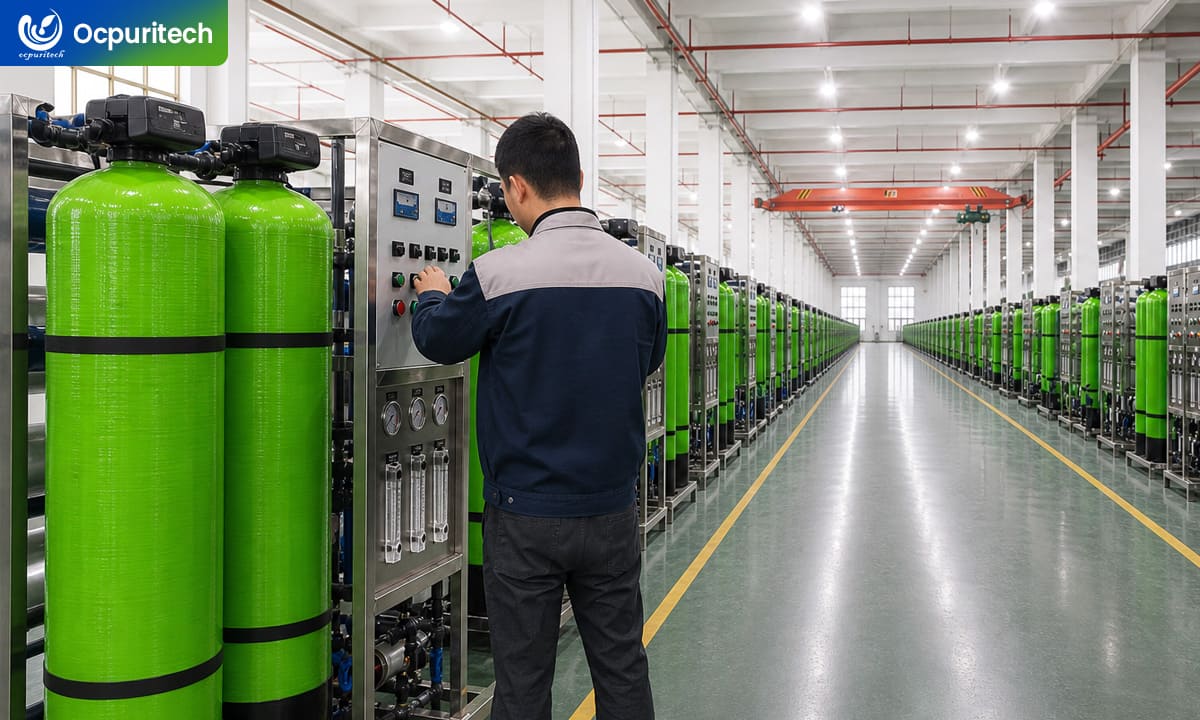
How to Choose a Reliable Well Water Treatment System Manufacturer?
Choosing a well water treatment system manufacturer requires evaluating its engineering capabilities, proposed system performance, and ability to support the project after delivery. The following criteria can help buyers compare suppliers before placing an order.
| Evaluation Criteria |
What Buyers Should Verify or Request |
| Water Quality Assessment |
Review of raw well water analysis, including TDS, hardness, iron, manganese, and other relevant contaminants. |
| Engineering & Process Design |
A proposed treatment flow diagram explaining the selection of filtration, softening, UF, or RO based on water quality requirements. |
| System Capacity & Performance |
Confirmed feed flow, finished water capacity, treatment recovery, target water quality, and specified operating conditions. |
| Equipment Quality & Components |
Specifications for pumps, membranes, filter vessels, piping materials, control systems, and major component brands. |
| Factory Testing & Quality Control |
Applicable inspection reports, factory acceptance testing (FAT) procedures, and agreed performance verification criteria. |
| Technical Documentation |
Process flow diagrams (PFD), equipment layouts, electrical drawings, operation manuals, and maintenance instructions. |
| Installation & After-Sales Support |
Commissioning assistance, technical troubleshooting, spare parts availability, and maintenance support. |
| OEM/ODM & Export Capability |
Equipment customization, private labeling, export packaging, and project-specific documentation. |
A reliable well water treatment system manufacturer should be able to explain why its proposed treatment process suits the raw water conditions and required finished water quality. Two quotations may appear similar, but differences in pretreatment, component specifications, and performance guarantees can significantly affect long-term operation.
For EPC contractors and international distributors, I recommend verifying these claims against the technical proposal rather than relying on verbal assurances. Check whether the design conditions, guaranteed performance, and scope of supply are clearly documented. Where factory acceptance testing (FAT) is required, agree on the test procedures and acceptance criteria before manufacturing. This makes supplier comparisons more transparent and helps reduce disputes during delivery and commissioning.
FAQs About Well Water Treatment Systems
Q: How Do I Choose the Right Well Water Treatment Systems Capacity?
Start with daily water demand and operating hours. Then consider treatment recovery, peak consumption, available storage, maintenance downtime, and the well’s sustainable yield.
Q: What Water Quality Tests Are Needed Before Buying a System?
Typical parameters include pH, turbidity, TDS, hardness, iron, manganese, and other contaminants relevant to the intended application. Drinking water projects require additional testing based on applicable standards.
Q: Can a Well Water Treatment System Remove Iron and Manganese?
Yes. Suitable treatment processes can reduce iron and manganese. The correct configuration depends on water chemistry, contaminant concentrations, and required removal performance.
Q: What Is the Difference Between Well Water Filtration and Reverse Osmosis?
Filtration generally targets particles or specific contaminants, depending on the technology. RO removes many dissolved salts and ions. The two processes serve different purposes.
Q: How Much Does a Commercial Well Water Treatment Systems Cost?
Pricing depends on capacity, water quality, treatment complexity, equipment materials, automation, and installation requirements. A detailed water analysis and project specifications are needed for an accurate quotation.
Provide the raw water analysis, required finished water capacity, target water quality, operating hours, application, and site conditions. These details help the manufacturer prepare a suitable preliminary proposal.
Conclusion
Choosing the right well water treatment systems starts with understanding the raw water, defining the required finished water quality, and calculating the actual production demand.
Filtration, softening, UF, and RO solve different water quality problems. The most suitable system is not necessarily the most complex one, but the configuration that meets the project’s requirements with reliable operation and manageable long-term costs.
Before purchasing, I recommend reviewing the treatment process, design capacity, operating costs, and manufacturer’s technical documentation.
Need a Customized Well Water Treatment Solution?
Ocpuritech provides customized water treatment equipment for commercial and industrial projects.
Share your raw water analysis, required capacity, and target water quality with our engineering team. We can review your requirements and recommend a suitable treatment configuration.