River water is one of the most accessible freshwater sources on the planet. But turn on the tap from a poorly designed system and the water can look clean without being safe. A properly designed river water filtration system can turn surface water into water suitable for its intended use, including drinking water when the treatment train is designed and verified to meet the applicable drinking water standard.
So what does that system include, and how do you specify one for your river? This guide walks you through it, step by step, from water testing to supplier qualification.
What Is a River Water Filtration System?
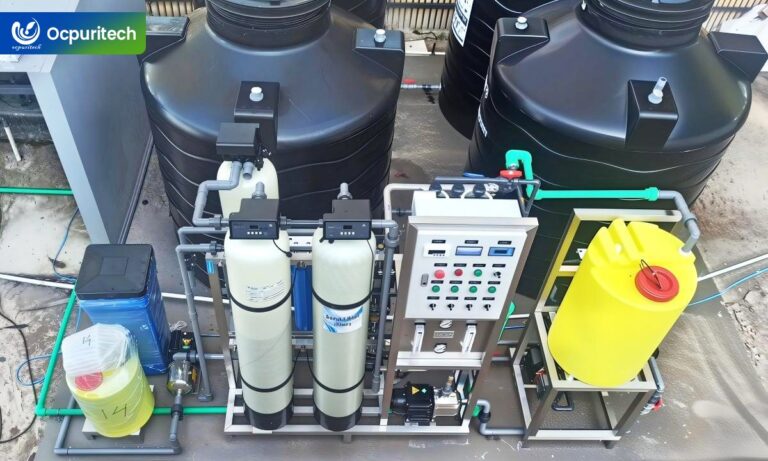
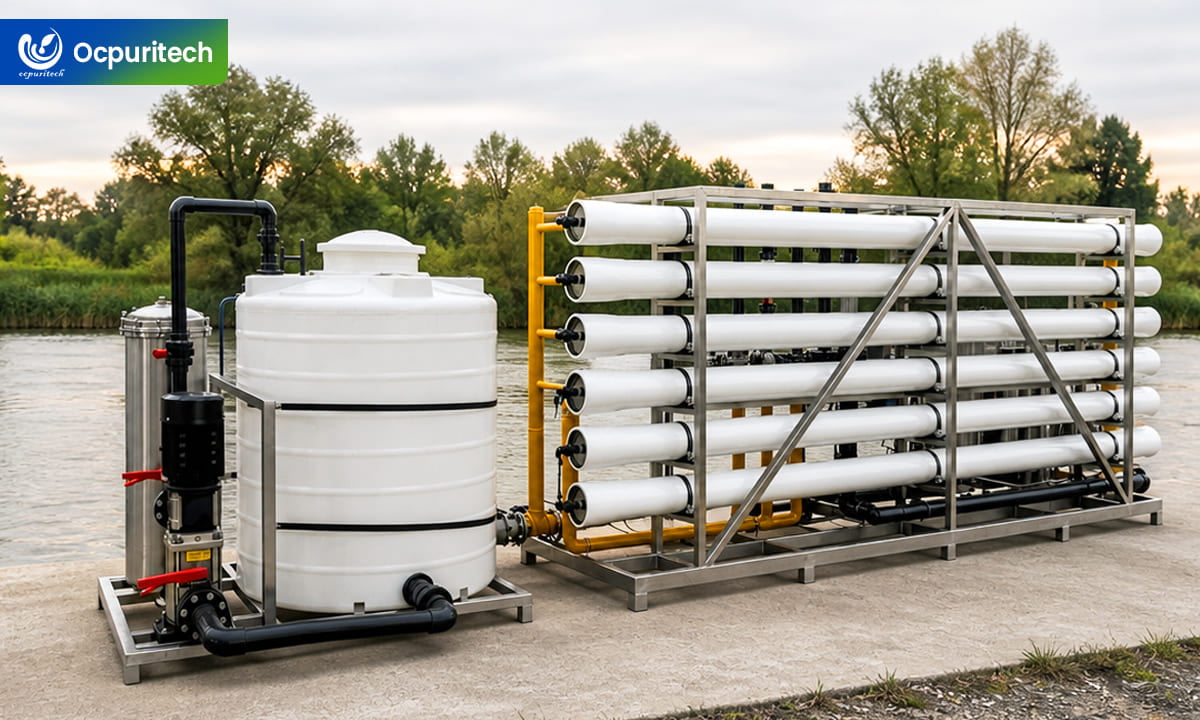
A river water filtration system is a treatment train designed to remove suspended solids, microorganisms, organic contaminants and, when required, dissolved salts from surface water.
| Stage |
Function |
Target at outlet |
| 1. Screening / grit removal |
Remove leaves, branches, coarse sand |
Visible debris removed |
| 2. Coagulation + flocculation |
Destabilise colloids, form flocs |
— |
| 3. Clarification / sedimentation |
Drop out flocs by gravity |
Turbidity cut before filters |
| 4. Multimedia filtration |
Remove residual suspended solids |
Feed suitable for membranes |
| 5. Activated carbon |
Adsorb organics, chlorine, odour |
Protects RO from oxidation |
| 6. Membranes (UF / NF / RO) |
Remove pathogens, colour, salts |
Depends on end use |
| 7. Disinfection (UV / chlorine) |
Inactivate microorganisms |
Meets applicable rules |
Important: outlet values depend on your raw water. This table isn’t a guaranteed specification — design targets have to be set against your own water report.
That word “system” is doing real work. A membrane element is a component; a system includes pretreatment, pumping, controls, CIP and concentrate handling. Buyers who compare component prices end up comparing incomplete scopes without realising it.
Step 1: Test Your River Water Before Sizing the Filtration System
I won’t quote a river water filtration system without a water report. Without data I’d be guessing, and so is anyone who hands you a price before asking for one. Request these from a certified laboratory:
| Parameter |
Why it matters |
Note |
| Turbidity (NTU) |
Drives pretreatment and clarifier sizing |
Sample dry and wet season |
| TSS (mg/L) |
Determines solids handling load |
— |
| SDI₁₅ |
Indicates particulate fouling potential for RO |
Measure after pretreatment |
| TDS (mg/L) |
Decides whether RO is required |
Rivers usually low vs seawater |
| TOC / COD |
Predicts organic and biofouling risk |
Often ignored, often the real problem |
| Iron / Manganese |
Causes irreversible fouling |
Needs oxidation + filtration |
| Hardness / LSI |
Predicts membrane scaling |
Drives antiscalant selection |
| Total coliform / E. coli |
Sets disinfection requirement |
— |
| Temperature (°C / °F) |
Flux changes with temperature |
Affects membrane area |
Sample twice — once in dry season, once in wet. If you’ve only got one sample, you’ve designed for half the year.
The wet-season trap nobody quotes for
River turbidity isn’t stable. In particular, it can climb sharply during heavy rain. As a result, a system sized only on dry-season data can be overwhelmed when turbidity peaks. Seasonal turbidity swings are a well-known challenge in surface water treatment, but they are often overlooked during preliminary system sizing.
Ask your supplier two questions: “What raw water turbidity was this designed for?” and “What happens when turbidity goes above that?” If either answer is vague, the system wasn’t designed for your wet season. How much margin you need depends on your river’s variability, so have a process engineer review the historic turbidity range before sizing. There’s no universal safety factor I can honestly quote here.
Step 2: Match Pretreatment to Your Water (Selection Table)
Here’s the table I kept looking for when I started out and never found. It maps raw water conditions to the pretreatment route a river water filtration system needs.
| Raw water condition |
Pretreatment route |
Reason |
| Low turbidity, stable |
Multimedia → carbon → cartridge |
Minimal solids load |
| Moderate turbidity, seasonal |
Coagulation → clarifier → multimedia → carbon → cartridge |
Colloids need destabilising |
| High turbidity, flood-prone |
Sedimentation → coagulation → clarifier → multimedia → UF |
UF holds SDI through feed swings |
| High iron or manganese |
Oxidation → manganese sand → multimedia |
Must oxidise before filtration |
| High TOC / organic load |
Coagulation → clarifier → carbon → UF |
Organics drive biofouling |
| High hardness feeding RO |
Antiscalant, or softener ahead of RO |
Prevents membrane scaling |
When I push buyers toward UF
If your river swings hard between seasons, ultrafiltration as pretreatment is usually worth the extra capital cost, and I’ll say so even when it makes our quote look more expensive than the one next to it.
However, conventional media filtration gives you variable SDI when feed turbidity changes. As a result, RO fouling becomes harder to predict. UF holds filtrate quality far more consistently across a wider feed range.
You pay more upfront, but the more consistent filtrate quality can reduce RO fouling risk, cleaning frequency and membrane replacement pressure when the raw water varies significantly.
Step 3: Size Your River Water Filtration System
Many river water filtration guides explain the treatment stages but give buyers little practical guidance on capacity sizing. For this reason, here is the basic approach we use: work backwards from your demand.
- Define net product water demand in m³/h, LPH or GPD, and include peak demand rather than just the average.
- Define your operating hours. A plant running 16 h/day needs different sizing than one running 24 h/day for the same daily volume.
- Apply the recovery rate. This is the step buyers often miss. In other words, your raw water intake has to be larger than your product output.
Feed Flow = Product Flow ÷ Recovery Rate
Worked example (illustrative arithmetic only — not a design). If you need 10 m³/h (2,642 GPH) of RO permeate at 70% recovery:
Feed = 10 ÷ 0.70 ≈ 14.3 m³/h (3,777 GPH)
Your intake pump, pretreatment and piping all have to handle 14.3 m³/h, not 10.
Critical caveat: that 70% is there to show the arithmetic, nothing more. What you can actually achieve depends on feed TDS, temperature, silica, hardness, LSI and what your permit allows for concentrate. I won’t put a recovery number on your project before I’ve read your water report, and I’d treat any supplier who does with real caution.
- Add backwash allowance. Media filters consume water when they backwash, and that comes straight out of net production.
- Correct for temperature. Membrane flux drops as water gets colder. A system sized at 25 °C (77 °F) underproduces in a winter river at 10 °C (50 °F), so ask for projections at your minimum temperature.
Two questions that break a bad quote
When a quotation lands on your desk, ask two things: “What’s the net product flow after backwash and CIP losses?” and “What feed water temperature is this performance based on?” Both answers should already be in the document. If the supplier has to go away and check, they haven’t done the engineering yet.
Step 4: Understand Concentrate Disposal Before You Buy
If your system includes RO, it produces concentrate (brine). Concentrate disposal is often addressed too late in the project. That can leave a completed plant unable to operate until the discharge route and permit are resolved.
Concentrate volume is the difference between feed and permeate — at the illustrative 70% recovery above, roughly 30% of your intake leaves as concentrate and has to go somewhere.
Three things to confirm before ordering:
| Item |
Question to answer |
Who decides |
| Discharge route |
River, sewer, evaporation pond or ZLD? |
Environmental authority |
| Discharge permit |
What limits apply at the discharge point? |
Local regulation |
| Pre-discharge treatment |
Does concentrate need further treatment? |
Depends on permit |
Discharge rules vary widely by country and watershed, so confirm requirements with your local environmental authority. I’ve watched a commissioned system sit idle for months because nobody applied for the permit. Start that process in parallel with procurement, not after the plant arrives.
Step 5: Build a Real Cost Model (CAPEX + OPEX)
The cost of a river water filtration system isn’t its purchase price. Here’s the structure I walk buyers through instead.
CAPEX checklist
| Item |
Quoted? |
Watch out for |
| Pretreatment equipment |
Sometimes |
The most common scope gap |
| Membranes and housings |
Usually |
Check brand and quantity |
| High pressure pump |
Usually |
Check brand and efficiency |
| Control panel / PLC |
Usually |
Check automation level |
| Intake pump and piping |
Often not |
Large hidden cost |
| CIP system |
Often not |
Required for any serious plant |
| Instrumentation |
Varies |
Turbidity, conductivity, flow |
| Installation, commissioning |
Often not |
Ask if travel is included |
| Freight, duty, insurance |
Per Incoterm |
Confirm FOB vs CIF vs DDP |
OPEX checklist
| Item |
Driver |
| Energy |
Specific energy consumption (kWh/m³) |
| Membrane replacement |
Fouling rate, feed quality, cleaning discipline |
| Media replacement |
Filter type and loading |
| Chemicals |
Coagulant, antiscalant, CIP chemicals, disinfectant |
| Labour |
Plant size and automation level |
| Concentrate disposal |
Local discharge route and permit |
| Downtime |
Reliability and spare parts availability |
On numbers: I’ve deliberately left cost-per-m³ figures out. These costs can vary significantly depending on local electricity tariffs, raw water quality, plant capacity, operating conditions and labour costs, so using figures from another country can easily lead to misleading conclusions.
Instead, send your project parameters and water data to our technical engineers. They will review your requirements and provide a customized treatment solution based on your actual conditions, typically within 24 hours.
Why the cheap quote usually isn’t cheap
Two quotes land with the same nominal capacity and a large gap in price. Hence, check the excluded scope before you celebrate. In my experience the cheaper one has left out pretreatment, CIP, or intake pumping. It isn’t cheaper, it’s incomplete, and once you add the missing scope back the gap shrinks or reverses. Furthermore, insist on a line-by-line comparison using the CAPEX table. Never compare bottom lines.
Step 6: How to Choose a Reliable River Water Filtration System Manufacturer
Search results include both manufacturers and trading companies, and the difference is not always obvious from a website alone. Here’s the checklist I’d use if I were buying:
What to Actually Look at on a Factory Visit
If you can get on a plane, skip the showroom and ask to see two areas. First, welding and assembly — workmanship on frames and piping tells you more about quality control than any certificate. Second, the test bay. A manufacturer who wet-tests before shipment has a real test area with instrumentation in it. A trading company has an office.
Our own plant is in Xinhui, Jiangmen. Use the same two checks anywhere you go.
Common Failure Modes and How to Avoid Them
These are six common failure modes I’ve encountered in river water treatment projects. In most cases, the root cause can be traced back to a decision made before the order was placed.
| Failure |
Root cause |
Prevention |
| Rapid membrane fouling |
Pretreatment inadequate for actual SDI |
Design for wet season, verify SDI₁₅ after pretreatment |
| Membrane scaling |
Hardness / LSI not evaluated |
Full analysis, correct antiscalant, review recovery |
| Biofouling |
TOC ignored, no disinfection plan |
Include TOC in analysis, plan CIP frequency |
| Underproduces in winter |
Sized at summer temperature |
Request projections at minimum temperature |
| Plant idle after commissioning |
Discharge permit not obtained |
Start permit during procurement |
| Frequent cartridge changes |
Upstream filtration undersized |
Review media sizing, consider UF |
FAQ
Can you drink river water after filtering?
Only with a complete treatment train. Filtration alone removes particles, not all pathogens or dissolved contaminants. Safe drinking water requires pretreatment, membrane separation and disinfection together. Final water must be verified against your local drinking water regulations.
Is river water safe to drink without treatment?
No. River water carries bacteria, viruses, parasites and chemical contamination that changes week to week. Drinking it untreated is a genuine health risk.
What filter should I use for high turbidity river water?
Don’t start with a filter at all. Start with coagulation and clarification to drop the solids load, then bring in multimedia filtration. For flood-prone rivers with wide turbidity swings, ultrafiltration holds output far more steadily than media filtration on its own.
Do I need RO for river water?
That depends on your end use and your raw TDS. Rivers usually carry lower TDS than seawater or brackish sources. If you need process water with low dissolved solids, or drinking water from a contaminated source, RO earns its place. If you only need turbidity and pathogen removal, UF plus disinfection may well be enough. Check it against your water report before you commit.
What is the difference between UF, NF and RO for river water?
UF removes suspended solids, bacteria and viruses, but not dissolved salts. NF removes divalent ions and colour, with partial salt rejection. RO removes almost all dissolved salts. Selection depends on your target water quality and operating cost tolerance.
How long do membranes last on river water?
That comes down to pretreatment quality, cleaning discipline and how much your feed varies. A well-pretreated system reaches normal service life. A poorly pretreated one can fail within months. I can’t give you a number without seeing what sits upstream of the membranes.
Is UV or chlorination better for river water disinfection?
They solve different halves of the problem. UV adds no chemicals and creates no byproducts, but it leaves no residual protection once water moves downstream. Chlorination carries residual protection through distribution but can form byproducts. If you have storage and a distribution network you generally need a residual, which is why plenty of plants run both.
How often should a river water system be monitored?
Operating parameters such as pressure differential, flow and conductivity should be logged routinely. Full water quality verification should follow your local regulatory requirement and your internal quality plan.
Can a river water filtration system be containerised?
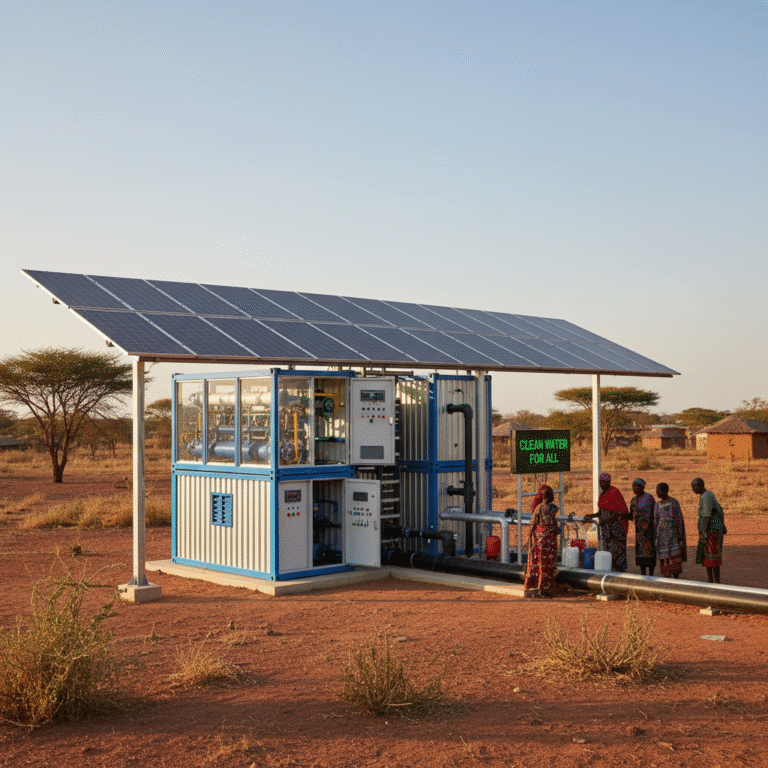
Yes. Containerised plants suit remote sites, temporary projects and locations with limited civil works. Capacity range and layout depend on your required flow and pretreatment complexity.
What information should I send to get an accurate quotation?
Four things: a laboratory water analysis, your required product flow including peak demand, your target water quality or the standard you have to meet, and your daily operating hours. With those on the table a real proposal is possible. Without them you’ll get a catalogue price dressed up as engineering.
Get a Design Review of Your River Water Filtration System
If you’ve got a water report, send it over. Our engineers will read it and tell you which process route fits your river water filtration system, what capacity you need, and where the scope gaps sit in the quotes already on your desk. If you don’t have one yet, we’ll tell you which parameters to test and why each matters.
We’ve delivered 10,000+ water treatment solutions to customers in more than 80 countries. You’re welcome to visit our Guangzhou office and discuss your project requirements directly with our engineers. Based on your raw water conditions, capacity and end-use requirements, our team can develop a customized water filtration solution for your project.
If you cannot visit in person, we can also provide a live view of our factory and production process so you can see where and how your system is manufactured. When you are ready to visit, we can also arrange transportation to our manufacturing facility in Xinhui, Jiangmen, Guangdong, China, where you can inspect our production, assembly and testing facilities firsthand.